How Much Does a Short Video Cost in 2026? Freelancer, Agency, In-House, AI and Automated
A branded short video costs €50 to €2,500 by hand, and one post is really five videos. What each way of making short-form video costs per post and per month.

Key takeaways
- A branded short video made by hand costs roughly €50 to €300 from a freelancer, €150 to €400 in-house and €200 to €2,500 from an agency.
- The unit price is misleading, because one post is really about five videos once aspect ratios and languages are counted.
- At two posts a day, hand-made production comes to €3,000 to €150,000 a month, which is why most organisations post far less than the platforms reward.
- Almost none of the cost is the craft. It is briefing, waiting, reviewing, re-cutting and correcting, which is exactly the part that can be automated.
Ask four suppliers how much a short video costs and you will get four answers between fifty euros and two and a half thousand. All four are honest. They are pricing different things: a freelancer with a template, an in-house designer’s afternoon, a studio with a producer attached, and an agency with an account manager in the room. This article lays out what a short video costs in 2026 for each way of making it, and why the unit price is the least important number in the calculation.
Short video production cost by supplier
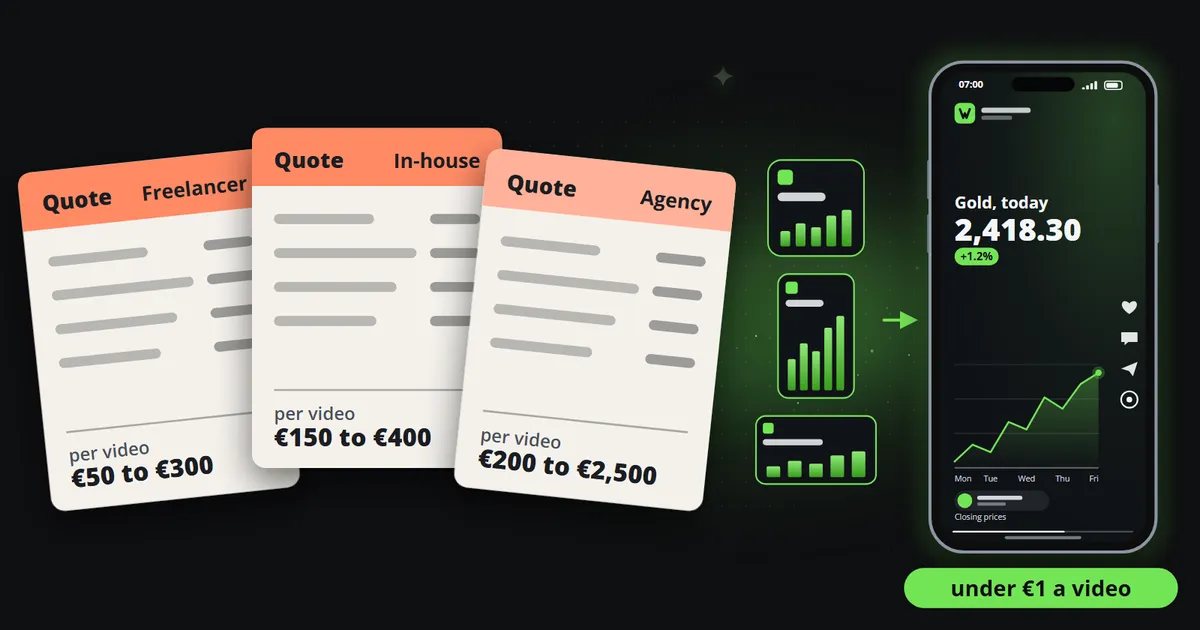
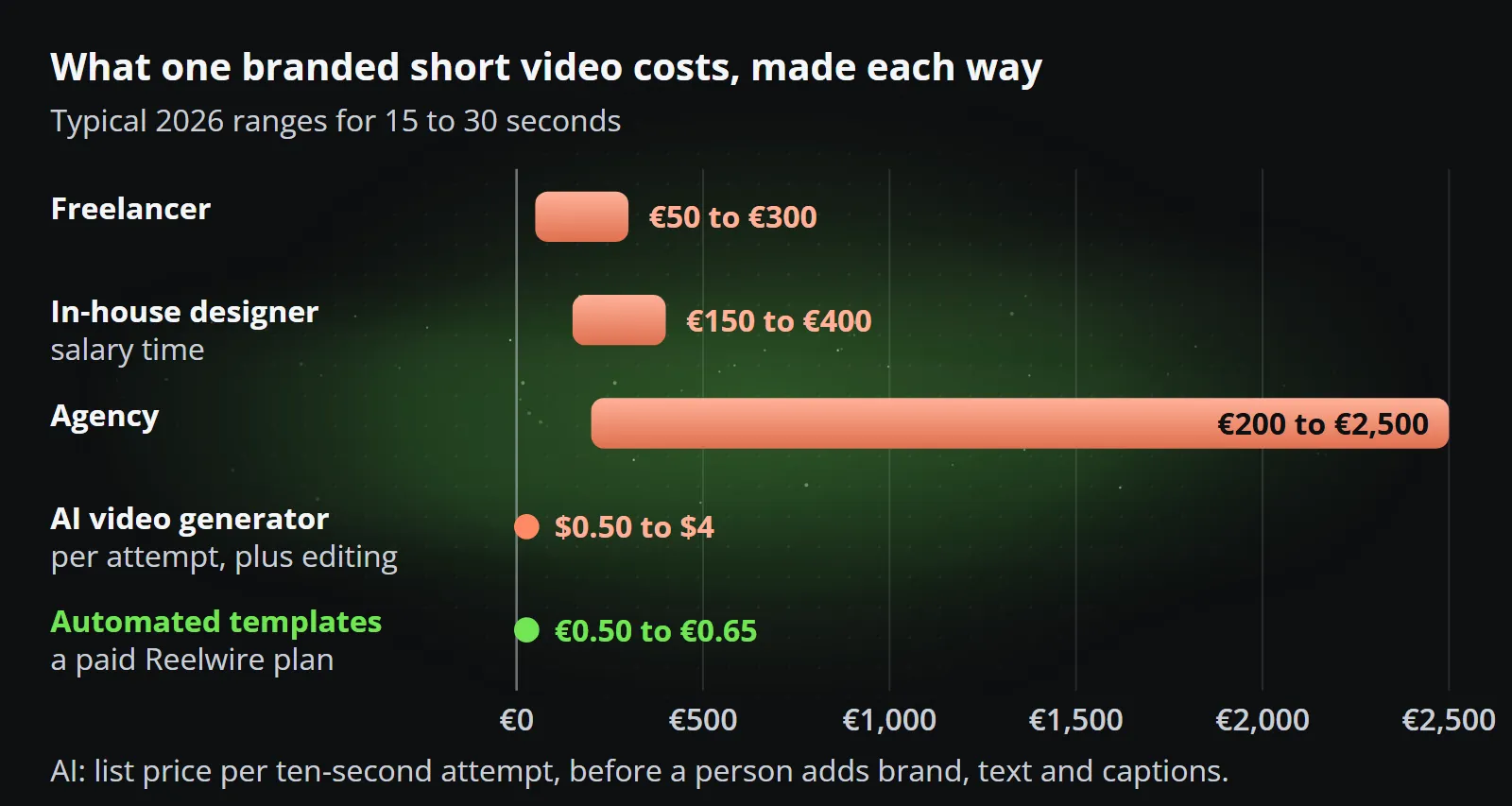
For a branded short video of fifteen to thirty seconds, made for social media, the going rates in 2026 look roughly like this:
| Who makes it | Typical cost per video | What you get |
|---|---|---|
| Freelancer | €50 to €300 | A clip from a template or a brief, one or two review rounds |
| In-house designer | €150 to €400 in salary time | Brand knowledge, but the same person also owns everything else |
| Agency | €200 to €2,500 | Strategy, production and review, at the speed of the agency’s calendar |
| AI video generator | $0.50 to $4 per ten-second attempt, plus editing | Footage, which still needs brand, text, captions and resizing by a person |
| Automated templates | €0.50 to €0.65 on a paid Reelwire plan | A finished, captioned, on-brand video drawn from your data |
The first three are the ranges most marketing teams recognise from their own invoices. The AI line is the list price per attempt from the major video models in September 2026. The details are in AI video generator vs template video.
On one scale in euros, the spread between the ways of making a video looks like this:
The number that matters is not the unit price
It is the unit price multiplied by the number you actually need, and that number is larger than it looks, for two reasons.
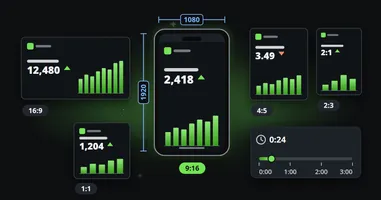
One post is really five videos. A post that goes to Reels, Shorts and TikTok needs a 9:16 version. The same post in a feed wants 4:5 or 1:1, and YouTube or LinkedIn want 16:9. Publish in two languages and every one of those doubles. A designed video with text and figures cannot simply be cropped from one shape into another, so each version is real work.
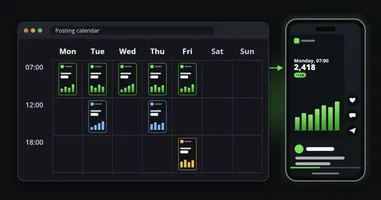
The platforms reward frequency. Short-form video is shown to people who do not follow you yet, and accounts that post regularly get more chances to be seen. Once a week builds little. Daily gives a channel the most chances to be seen.
Put the two together:
| Rhythm | Videos per month (5 per post) | By hand at €50 | By hand at €500 |
|---|---|---|---|
| One post a week | about 20 | €1,000 | €10,000 |
| One post a day | about 150 | €7,500 | €75,000 |
| Two posts a day | about 300 | €15,000 | €150,000 |
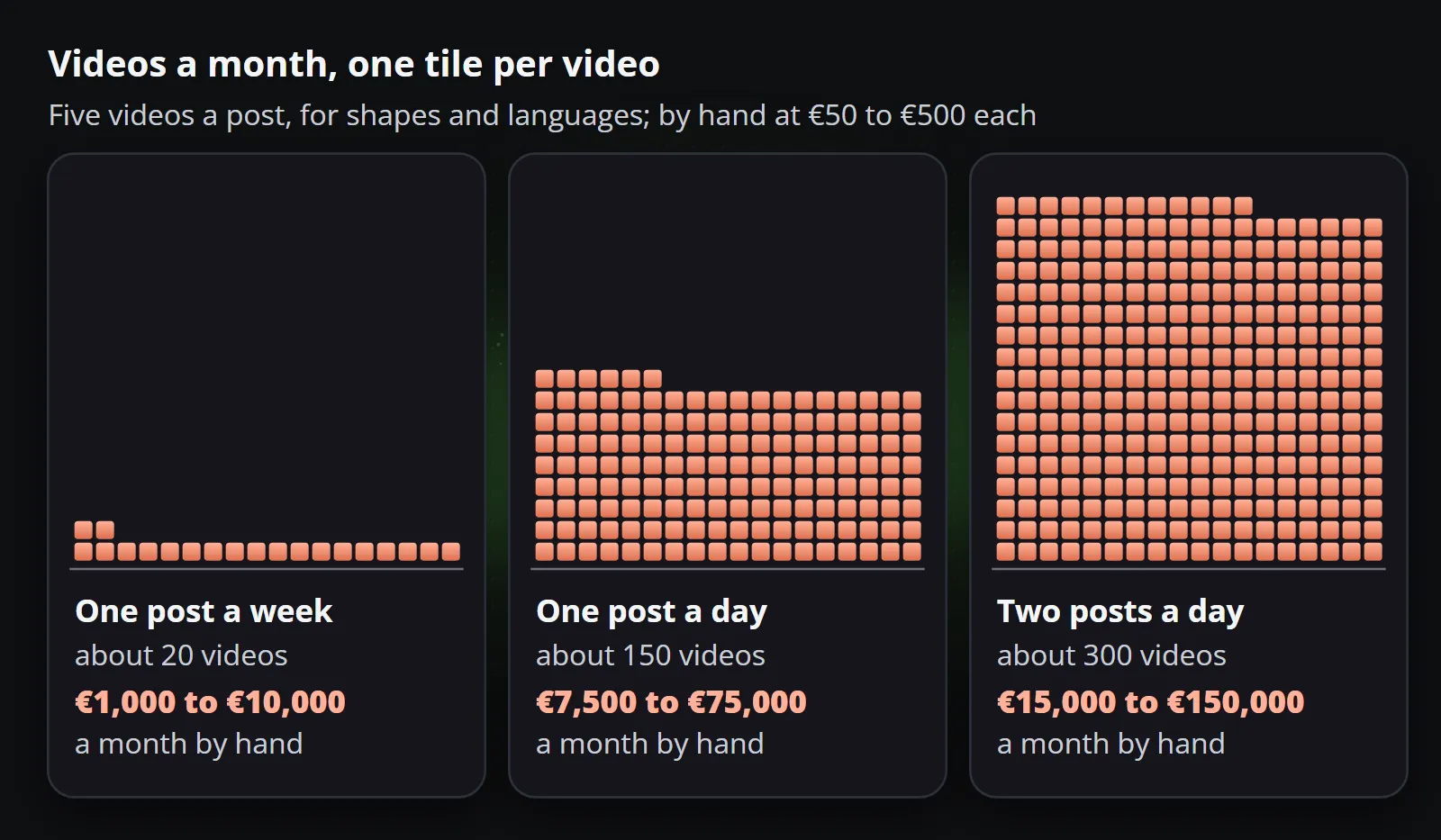
Even counting each post only once, two posts a day at €50 to €2,500 each comes to €3,000 to €150,000 a month; counting every version makes it several times that. This is the point at which most organisations quietly decide to post less. Not because less is better, but because the production model priced them out of their own strategy.
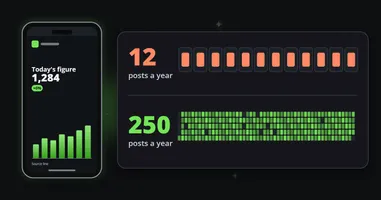
Drawn as one tile per video, the step from a weekly post to two a day looks like this:
Where the cost actually goes
Almost none of the cost of a short video is rendering, and surprisingly little of it is design. It goes into:
- Briefing. Explaining the same thing again in an email, for every clip.
- Waiting. The clip exists on somebody else’s schedule, so time-sensitive posts are late.
- Reviewing. Finding the one wrong number on the third revision.
- Re-cutting. The same clip again for every shape and every language.
- Correcting. The brand changed, or a figure was wrong, and forty clips did not get the memo.
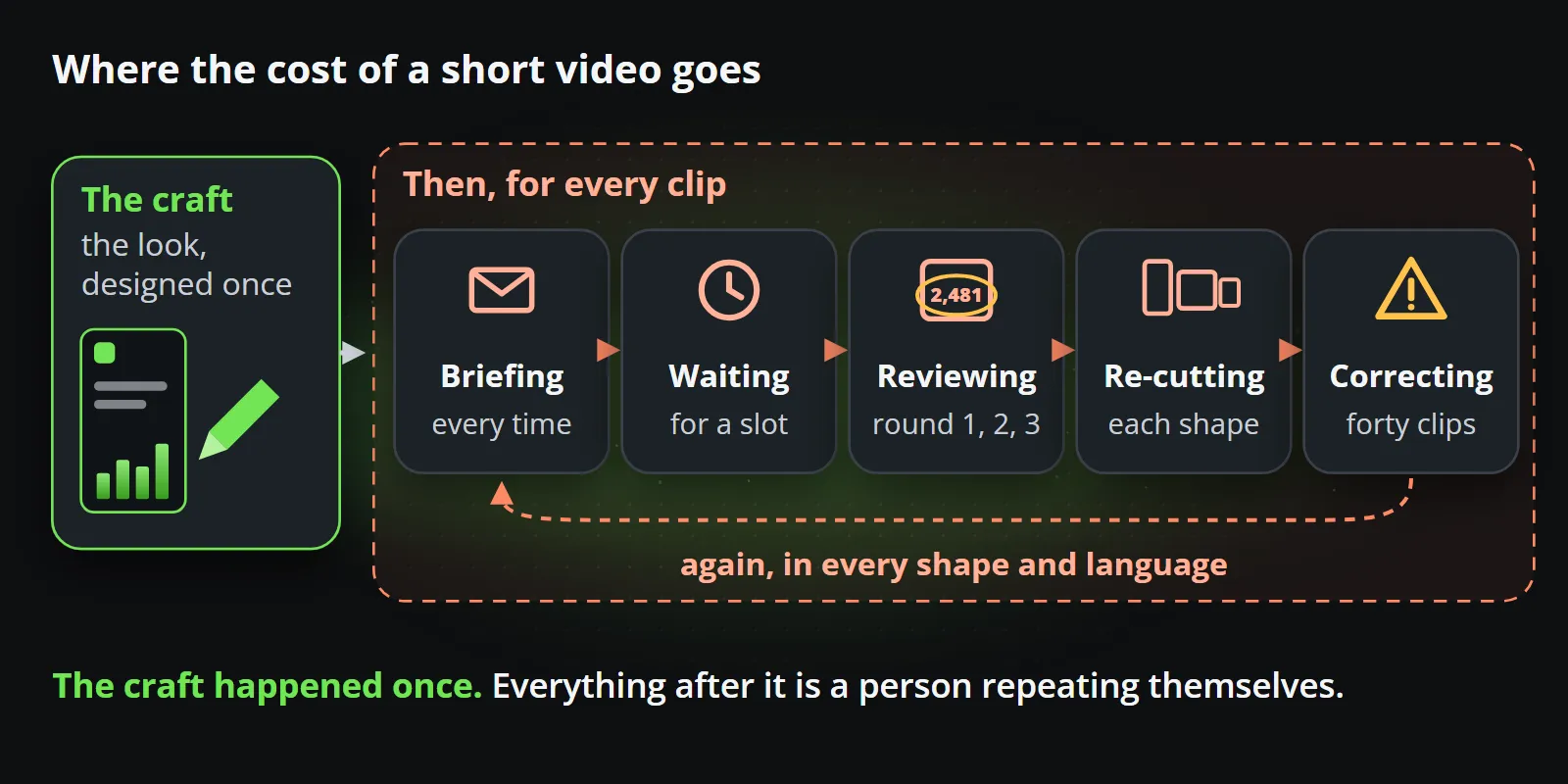
Every one of those is a coordination cost rather than a craft cost. The craft happened once, when somebody designed the look. Everything after that is a person repeating themselves.
Drawn as the life of one clip, the craft sits at the start, and everything after it comes round again:
What the €50 hides
The cheapest quote is rarely the cheapest video. A €50 freelance clip usually includes one round of changes, one shape and one language. The second review round, the vertical version, the German caption and the corrected figure are each a new small invoice or a new evening of somebody’s time. In-house, the cost hides differently: the designer who makes the daily clip is not making the landing page, the newsletter or the trade fair stand, and those are the projects that slip.
So when you compare quotes, compare the cost of a finished post: every shape, every language, every review round, and the hour somebody on your side spends briefing and checking it.
What about AI video?
Generative video looks like the way out, and for footage it often is. For posts built on facts it moves the cost rather than removing it. One ten-second attempt costs between about $0.50 and $4 at list prices, a usable clip often takes several attempts, and the result still needs the logo, the real figure in a real font, the captions and every other aspect ratio added by a person. The expensive part, a person finishing it, is still there. AI slop covers what happens when that finishing step gets skipped.
The automated alternative
Templates attack the coordination cost directly. A designer builds each format once, with fields for the headline, the figure, the date and the picture. From then on, new data fills the template and every version is drawn automatically, in every shape and language the channels need. There is no brief, because the data is the brief; no waiting, because the clip is drawn when the data arrives; and no re-cutting, because every shape comes from the same design.
On Reelwire’s paid plans that works out at 50 to 65 euro cents a finished video, captioned and handed over when it is due, and the free plan includes 15 videos a month with no card. Pay for the craft once, then pay for the volume at machine cost.
When paying more is the right call
Not every video should be automated, and the expensive options are expensive for good reasons. Pay for people when:
- It is a campaign, a launch or a brand film, where the idea is the value.
- It needs a face or a voice: an interview, an opinion, a customer story.
- It happens once, so there is nothing to repeat.
A sensible budget splits the two: people for the moments that need judgement and personality, and templates for the factual, recurring volume that keeps a channel present every day. The second part is usually most of the posts and a small part of the spend.
A quick way to estimate your own cost
- Count the posts you would publish if production were free, per month.
- Multiply by the number of shapes and languages each one needs.
- Multiply by your real cost per version, including the internal time to brief and review.
- Compare that with what you publish today. The gap is the reach you are not buying.
Faceless videos for business shows which formats suit the automated part, and the use cases show what they look like in your industry.
Frequently asked questions
How much does a 30-second social media video cost?
Made by hand, a branded 30-second clip typically costs €50 to €300 from a freelancer, €150 to €400 in internal time, and €200 to €2,500 from an agency, depending on how much design, motion and review is involved.
Why are short videos so expensive to produce?
Because each one needs a person to brief, make, review, resize and correct it, and because one post usually needs several versions for different platforms and languages. The coordination costs more than the design itself.
Are AI-generated videos cheaper?
Per attempt they can look cheap, from about $0.50 to $4 for ten seconds at list prices in September 2026. But a usable clip often takes several attempts, and a person still has to add the brand, the text and the captions, so the cost per finished post is higher than it looks.
What is the cheapest way to post a short video every day?
Automating the recurring posts with templates. A designer builds each format once, data fills it, and every version is drawn automatically. On Reelwire's paid plans that works out at 50 to 65 euro cents a finished video, and there is a free plan of 15 videos a month.
Make your first clips today
The free plan makes 15 clips a month and asks for no card. Add your logo and colours, pick a template, and see a finished clip in your own brand before you decide anything.

Co-founder of Reelwire. Every organisation has facts worth showing, its prices, results, releases and warnings, and the vision is that every one of them can show those facts every day, on brand, in every format and language, without a production team behind each post. On brand, every day: correct, recognisable and consistent from the first clip to the thousandth.