The Process Is What Makes Your Channel Valuable: Brand Consistency on Social Media, Not the Perfect Short
One polished short a month, or a simple, correct fact every weekday? Why brand consistency on social media comes from a process, not from the perfect post.

Key takeaways
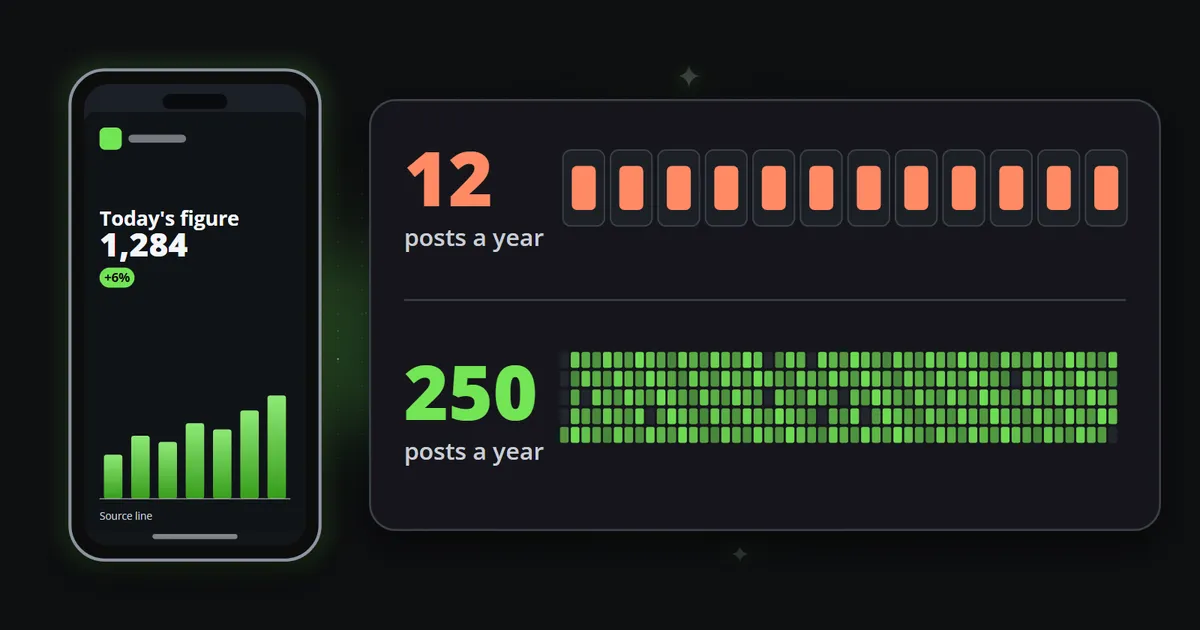
- A channel is valued like a habit, not like a film. Over a year, one polished short a month is 12 chances to be seen; one simple, correct fact every weekday is about 250.
- Quality for a brand channel means the same look, correct facts and posts on time, every time. Peak production value on a few posts does not add up to a recognisable channel.
- Research on how brands are remembered, from the Ehrenberg-Bass Institute and from Les Binet and Peter Field for the IPA, describes memory built by repetition over time and fading without it. It is about advertising, and it is evidence about memory, not a promise of results.
- The asset is the process: sources, templates, approval, a schedule and a hand-over that keep running in a busy month, when nobody has time to make a post.
Most advice about short-form video is about the single post: the hook, the edit, the trend, the clip that took off. This article is about the opposite. Brand consistency on social media comes from what happens every week, not from what happens once, and what makes a channel valuable is the process behind it rather than any one piece of content.
That is not an argument against good content. It is an argument about where the value sits. A brand channel is valued the way a habit is valued: by showing up, recognisably, with something worth a few seconds, again and again. One comparison makes it concrete.
Two channels, one year: what do 12 posts and 250 posts add up to?
Channel A posts one polished short a month. Each is a small production: an idea, a script, filming or animation, an edit, music, a round of feedback. It looks excellent.
Channel B posts one simple, interesting fact every weekday: a figure, a date, a result, an offer, in the same branded frame every time, drawn from a template and checked once. It looks consistent rather than spectacular.
Here is the arithmetic of a year. Five weekdays for 52 weeks is 260, so about 250 (assuming around ten public holidays):
| After one year | Channel A: polished and rare | Channel B: simple and steady |
|---|---|---|
| Posts | 12 | About 250 |
| Time between posts | About a month | One working day |
| Chances to be noticed | 12 | About 250 |
| Posts in the archive | 12 | About 250 |
| What one weak post costs | A month of presence | A day |
None of these numbers promises reach, followers or sales. What they describe is opportunity: how often the brand is in front of the people who follow it, and how much there is to find later.
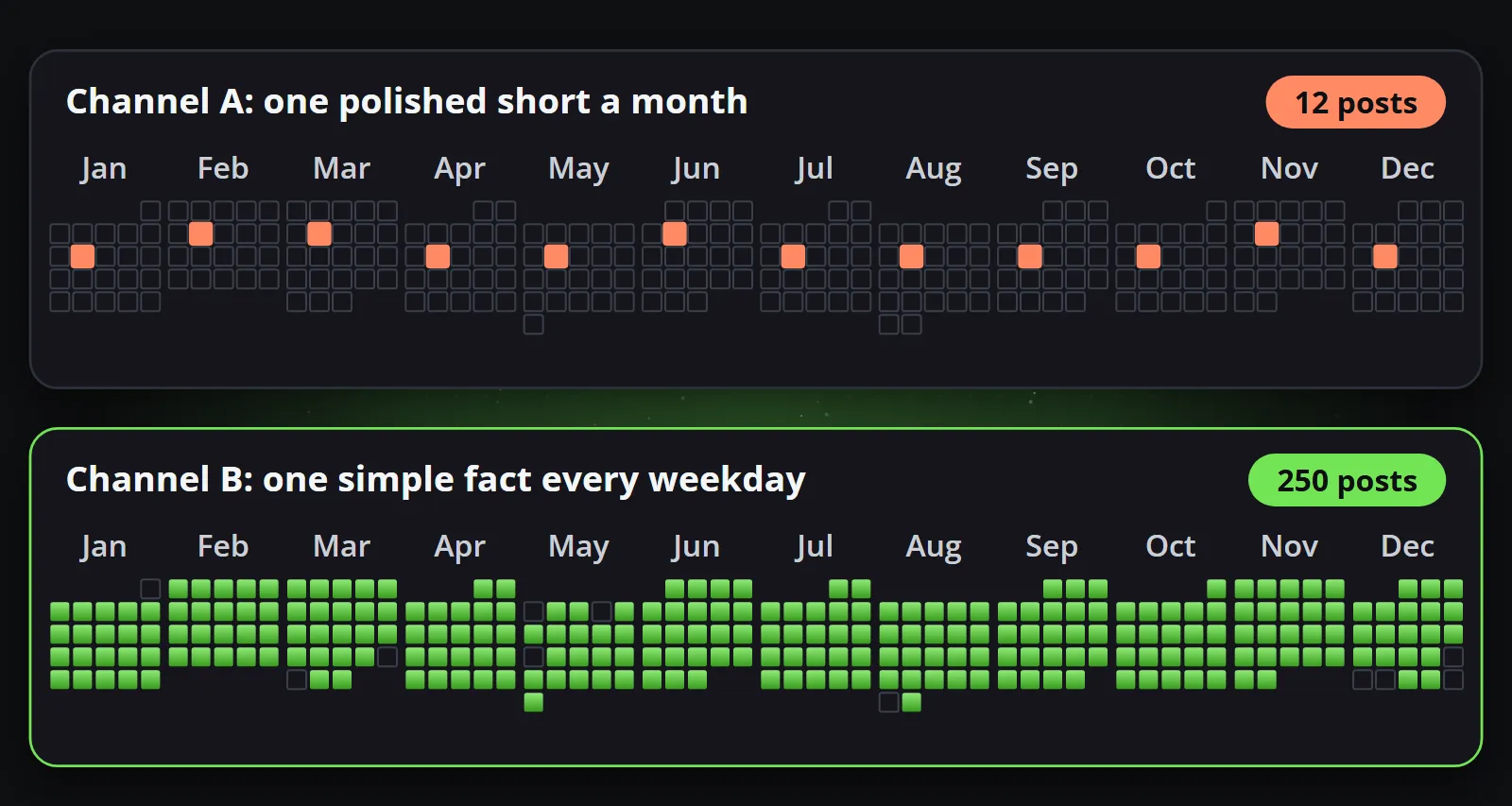
Notice what a weak post does to each. Each of A’s posts carries the weight of a month: if one misses, because the hook was weak, the news was busy or nobody happened to be scrolling, the channel has nothing to show until the next one. Each of B’s posts carries the weight of a day, and another follows tomorrow.
Why is the single brilliant short the hype?
The stories people tell about short-form are about outliers: the clip that reached millions, the small brand that went viral overnight. Outliers are real, and they are memorable precisely because they are rare. Planning a channel around them means planning around the part you control least.
The polished-and-rare channel also has costs that do not show in any one post:
- Effort is concentrated. Weeks go into one post, so every post has to justify that cost, which tends to make teams post even less.
- The gaps are long. A month of silence is long enough for followers to forget what the channel is for.
- It depends on people. The channel runs on the skill and the time of one or two people. When they are busy, ill or gone, it stops.
- It burns out. A production every month on top of everybody’s real job is the kind of plan that is quietly abandoned in the third month.
None of this is a case against polished work. A launch, a campaign or a brand film deserves it, and some of the best brand moments are exactly that. The point is that a few productions are not a channel.
What should “quality” mean for a brand channel?
For a brand channel, quality is not the peak of one post. It is the floor under every post, the standard the worst day still meets:
- Recognisable. The same logo, colours, typefaces and frame in every post, so somebody knows whose it is before they read a word. Your thousandth clip should look like your first goes into what that takes at volume.
- Correct. The figure, the date and the price are right every time. A typo in a number costs more trust than a plain frame ever will.
- On time. The Monday post is there on Monday. Rhythm is part of the content.
- Readable. The right shape for the platform, no text cut off, in the language of the audience.
- Worth a few seconds. A fact somebody did not know, a figure they wanted, a date they need.
Notice that production value is not on that list. A simple post that meets all five is higher quality, for a brand, than a beautiful one that arrives once a month with an outdated figure in it.
Brand consistency on social media: what does research say about being remembered?
Two bodies of marketing research are often cited on this, and both are worth describing as they were published rather than as slogans.
The Ehrenberg-Bass Institute at the University of South Australia describes the goal of brand building as mental availability: how easily a brand comes to mind when somebody is in a situation to buy. Much of its work is about distinctive assets, the colours, logos, shapes and sounds people link to one brand. Its own page on measuring them says that distinctive assets “only work if they are clearly and uniquely linked to your brand” and should be “developed and protected over the long term”. In a Q&A on what happens when brands stop advertising, the Institute’s Dr Nicole Hartnett describes these assets as memory structures that degrade without reinforcement: “people won’t forget a brand’s distinctive assets overnight. Or even years. But people will forget them eventually.”
The IPA published Les Binet and Peter Field’s The Long and the Short of It in 2013, a meta-analysis of 996 campaigns for 700 brands in 83 categories from its effectiveness databank. Their summary presentation puts it plainly: “No long term effects without short term. But short and long term effects are different.” Sales activation gave narrower, earlier effects and smaller paybacks; brand building gave broader, slower effects and bigger paybacks, building over years with repeated exposure. The balance that produced the most very large effects was about 60% brand building to 40% activation, and their later report for the IPA, Effectiveness in Context (2018), put it at 62:38, according to the IPA’s own account (both checked on 14 October 2026).
What this research does not say matters as much. Both bodies of work are about advertising, most of it paid and most of it from before short-form video existed; in the 2013 data, social media was not among the channels that added brand effects. Neither says that posting a fact every weekday will grow a brand, and nothing here promises reach, followers or sales.
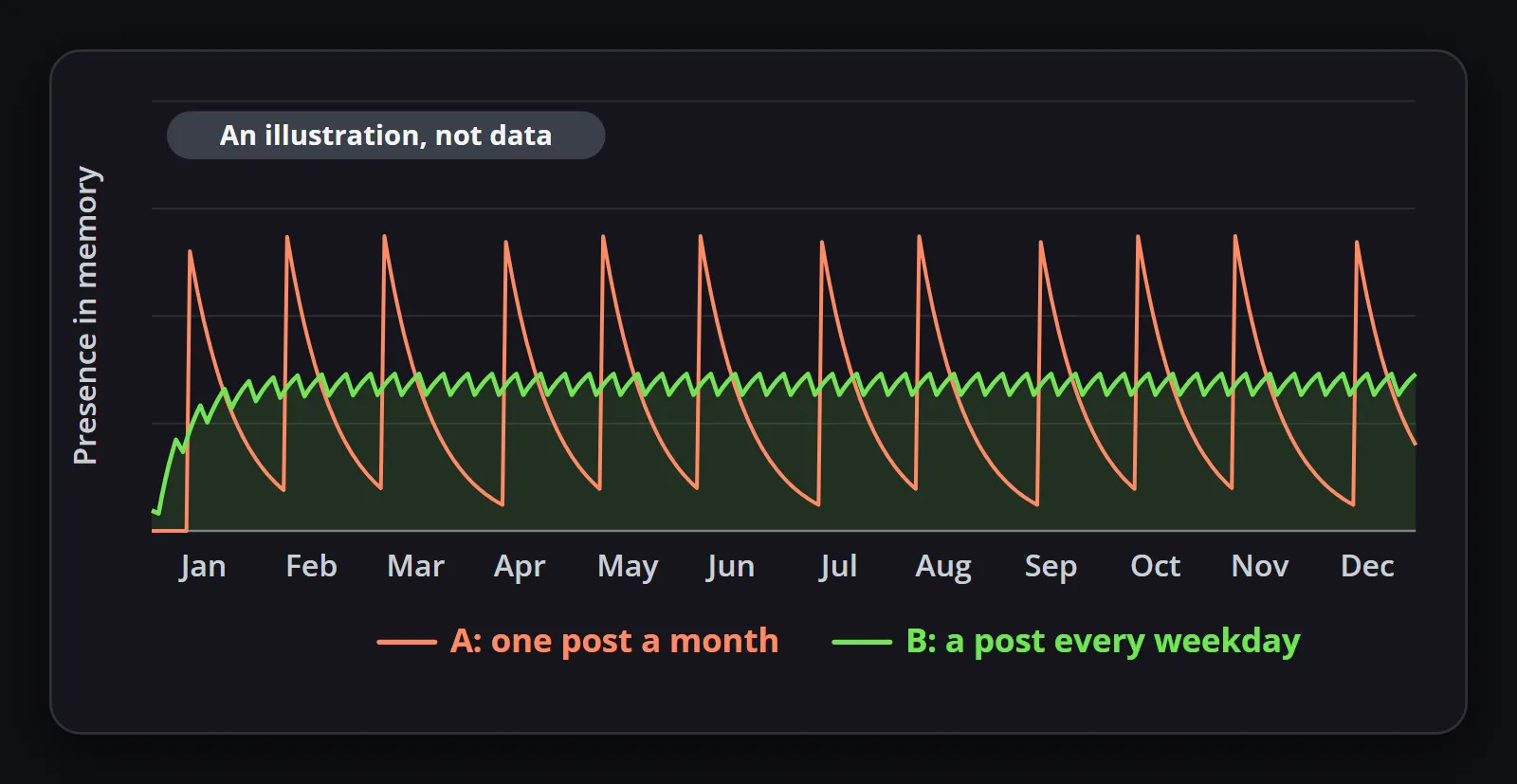
What they do describe is how memory works: a brand is remembered when its recognisable assets are seen repeatedly over time, and forgotten slowly when they are not. A consistent channel is one more place where those assets are seen, in the same form, week after week. The drawing below is an illustration of that idea, not data.
The long tail: why does an archive of small useful posts keep working?
After a year, channel B has something channel A does not: an archive of about 250 small posts on the subjects the brand wants to be known for. That is a long tail in the original sense, many small items each found by a few people, adding up to more than a handful of big ones.
- Each post answers a narrow question. Last month’s figure, a date, a comparison. On platforms with search, a narrow answer can be found long after it was posted.
- A newcomer scrolls back. Somebody who discovers the channel in November finds a body of work, not a gap since the last production.
- A series sets expectations. “The Monday figure” or “Friday’s results” tells people what the channel is for, which is the start of a habit.
- The format becomes an asset. Being the brand that posts this, in this frame, every week, is itself something people learn to recognise.
None of this guarantees that anybody searches. It means there is something to find when they do. Channel A’s archive is twelve posts and whatever trend each one followed.
Why is the process the asset?
The value of channel B is not any one of its facts. It is the machine that makes the facts appear, on time and in the same frame, whatever else is happening that week. That machine has five parts:
- Sources. Where the facts come from without somebody researching every morning: a feed of public data, a system the business already runs, or a list of posts written in advance.
- Templates. The look decided once, with the brand applied and every field held to its limit, so a headline that is too long is caught rather than cut off.
- Approval. Checked once, where it matters, rather than every post queued behind a busy reviewer.
- A schedule. When each kind of post goes out: as the data arrives, or on set days and times.
- A hand-over. How the finished post reaches the platform, and who confirms it went out.
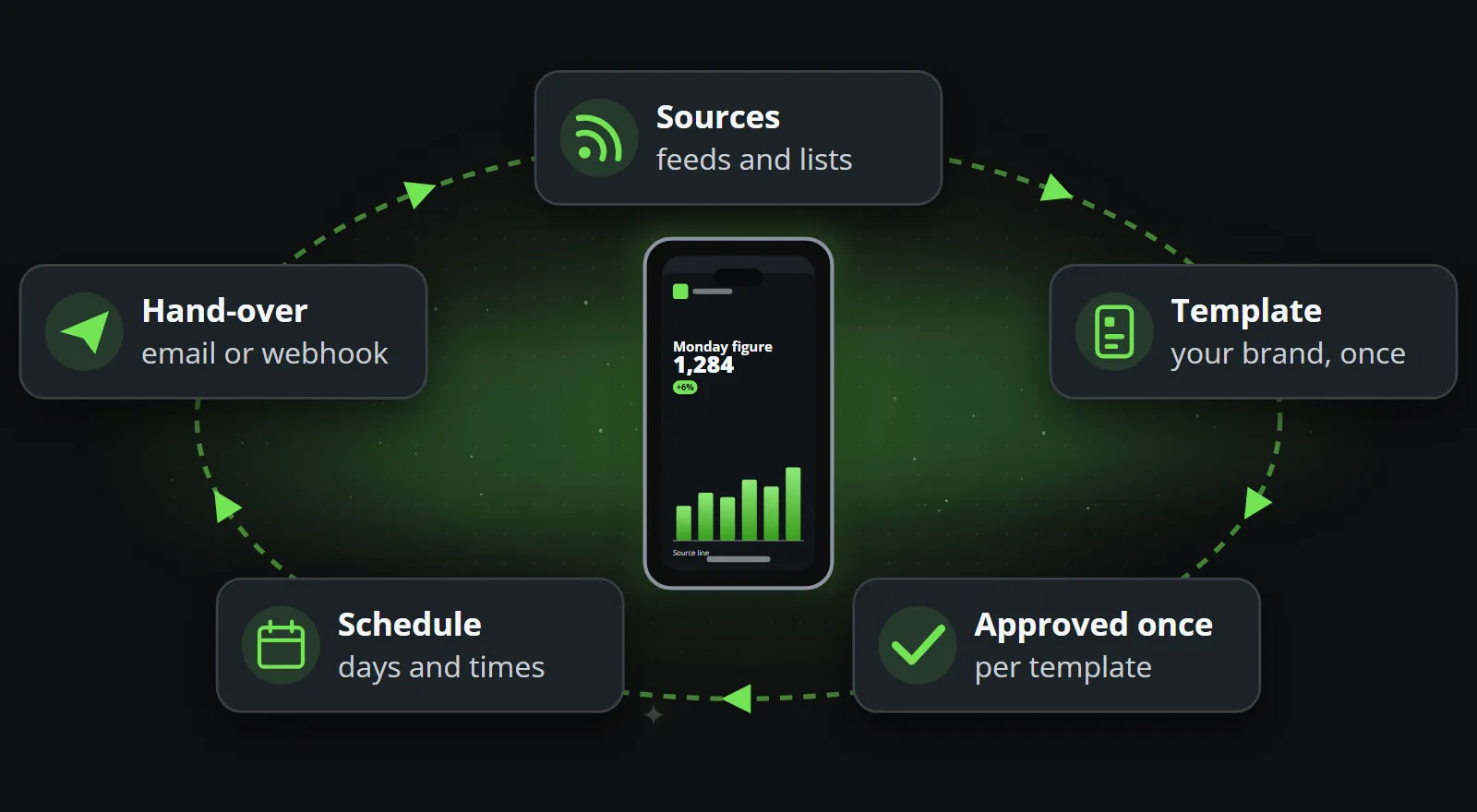
This is what Reelwire is built around. A channel listens to its sources: Reelwire’s ready-made feeds of live public data, your own system sending events over the API, or a post list written in advance. Every clip is drawn from a template in your brand, in the channel’s shape and language. A reviewer approves a template version once and every clip from it inherits that approval, with a check per post available for channels that need one. Each source can have its own release schedule, and the finished post is handed over by email or webhook, or posted directly to Discord, LinkedIn (a personal profile), Slack or Telegram. Data to video shows the sources in detail, and faceless videos for business shows the kind of channel this makes when nobody has to appear on camera. How it works shows the whole chain.
How do you start a process that survives a busy month?
- Pick one series. One kind of fact the brand should be known for, not ten. A weekly figure, the day’s result, this week’s offer.
- Find its source. If the fact has to be researched by hand each time, the series will stop the first busy week. Prefer data that arrives by itself.
- Decide the look once. One template, in the brand, in every shape you publish. Then leave it alone for a while: recognition needs repetition.
- Approve the template, not every post. Move the check to where it can be done once, and keep a per-post check only where the stakes call for it.
- Set a rhythm you can keep in your worst month. A post every weekday that never stops beats a post every day that stops in March.
- Decide who posts, and how. By email for a person to post from a phone, by webhook into a system or a posting service, or directly where a connector exists.
- Review monthly, not daily. Look at the series as a whole: is it recognisable, correct and on time? Change the template on purpose, not the posts by accident.
Bottom line
A polished short is a good post. A process that produces a simple, correct, recognisable post every weekday is a channel. The first depends on how good a particular day was; the second keeps a brand in front of the people who follow it whether anybody had time that week or not, and leaves an archive behind it.
If you want to see what a steady series looks like on your own data, start with Reelwire’s free plan: 15 videos a month, no card needed.
Frequently asked questions
What is brand consistency on social media?
Being recognisably the same brand in every post: the same logo, colours, typefaces and tone, the same kind of useful content, at a rhythm people can rely on. It is built by repetition, so it depends more on how a channel is run than on any single post.
How often should a brand post to stay consistent?
As often as it can keep up, every week, with something worth saying and without the team burning out. Once posts come from a process rather than from a person's effort each time, a post every weekday is realistic for a small team; one a month is too rare for anybody to form a habit.
Does posting every day lower the quality?
Only when quality depends on somebody's effort each day. When the look, the checks and the schedule are built into templates and a process, the two hundredth post meets the same standard as the first, because nobody had to make it by hand.
What is mental availability?
The Ehrenberg-Bass Institute's term for how easily a brand comes to mind when somebody is in a buying situation. Its researchers describe distinctive assets, such as colours, logos and shapes, as memory structures that have to be reinforced, or people eventually forget them.
Does one viral video build a brand?
It can bring a lot of attention once. Research on advertising describes brand memory as built by repeated exposure over time and fading slowly without it, so a hit with nothing after it is attention without a habit. Nobody can plan a channel around a hit.
Make your first clips today
The free plan makes 15 clips a month and asks for no card. Add your logo and colours, pick a template, and see a finished clip in your own brand before you decide anything.

Co-founder of Reelwire. Every organisation has facts worth showing, its prices, results, releases and warnings, and the vision is that every one of them can show those facts every day, on brand, in every format and language, without a production team behind each post. On brand, every day: correct, recognisable and consistent from the first clip to the thousandth.