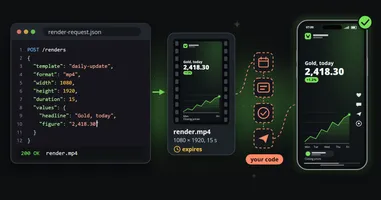
Claude Code and Remotion: Why Not Have My AI Assistant Build This?
Claude Code and Remotion make a first clip in an afternoon. What breaks in the months after it, and the part that keeps running when it does.

Key takeaways
- An assistant such as Claude Code, with Remotion and a scheduled task, really can build a branded clip from live data in an afternoon, and the code is yours to change.
- What it builds depends on things its builder does not control: sources change their format, headlines and languages outgrow the layout, platforms change their APIs and tokens, and a render machine has to be awake every morning.
- A cron job has no approval step and keeps no record, so the first person to check a post is its audience, and nobody can show later what went out.
- Reelwire is the part that keeps running, and the assistant keeps its job: connected through the MCP server, it decides and writes while Reelwire renders exactly and keeps posting.
Sooner or later every technically minded buyer asks it, usually after an evening with Claude Code: why not have my assistant build this? Point Claude Code, or Codex, or Cursor, at Remotion, ask for a daily clip from a data source, add a scheduled task, and a branded video renders from live data before dinner. It is a fair question, and the people asking it are usually right that they could.
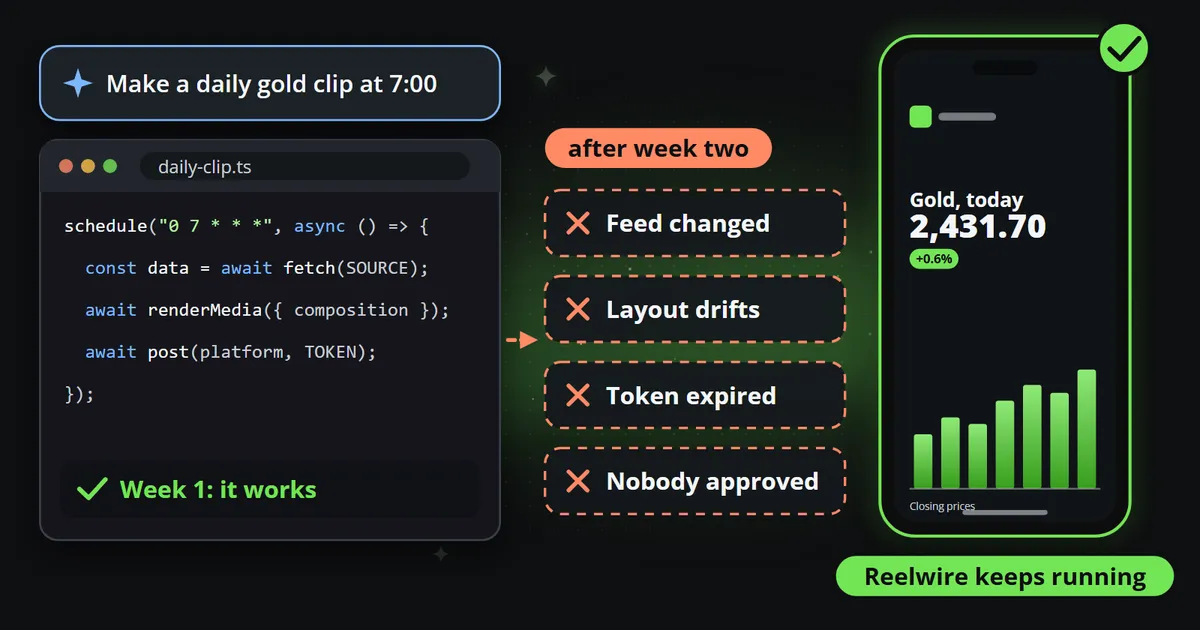
The short answer: it works for two weeks. Then a feed breaks, a layout drifts, a platform API changes, and nobody approved anything. Reelwire is the part that keeps running.
This article takes both halves seriously: what Claude Code and Remotion genuinely do well, what happens to a homemade pipeline in the six months after the demo, and where the assistant fits once something else carries the running. Every outside fact was checked on the source’s own pages on 16 October 2026.
What Claude Code and Remotion do well
Remotion is a framework for making videos with React: a video is a component, each frame is a function of time, and its renderer draws every frame in a headless browser and encodes them into an MP4. Because a video is code, it is exactly what a coding agent is good at, and Remotion’s makers publish Agent Skills that teach agents such as Claude Code, Codex and Cursor to work in a Remotion project the recommended way.
Ask for “a daily clip of the gold price in my brand colours, posted at seven” and an assistant writes four things that work on the first day:
- A fetch that reads the price from a source.
- A composition that lays out the headline, the figure, a chart and the logo.
- A render that turns it into an MP4 with Remotion’s renderer.
- A post that sends the file and a caption to a platform’s API, started by a scheduled task: a cron job on a server, a scheduled GitHub Actions workflow, or the assistant’s own scheduler.
That deserves real credit. The first clip does take an afternoon. You control every frame, any data source and anything a browser can draw, the code sits in your own repository, and the running cost is the machine it runs on plus, for a company of four or more, Remotion’s licence: it is free for individuals, companies of up to three employees and non-profits, and a larger company needs a paid company licence, priced per seat or per render (licence and prices, checked on 16 October 2026).
It is also fair to say that the library is not the difference. Reelwire’s own templates are Remotion projects. What separates a demo from a channel is everything around the render, and that is where the next six months go.
What breaks in a homemade video pipeline, and when?
Nothing below is exotic. Each item is a part of the build that worked on day one and depends on something its builder does not control. The timing is a typical course rather than a measurement, but the order is common: the data first, then the layout, then the platforms, then the questions nobody planned for.
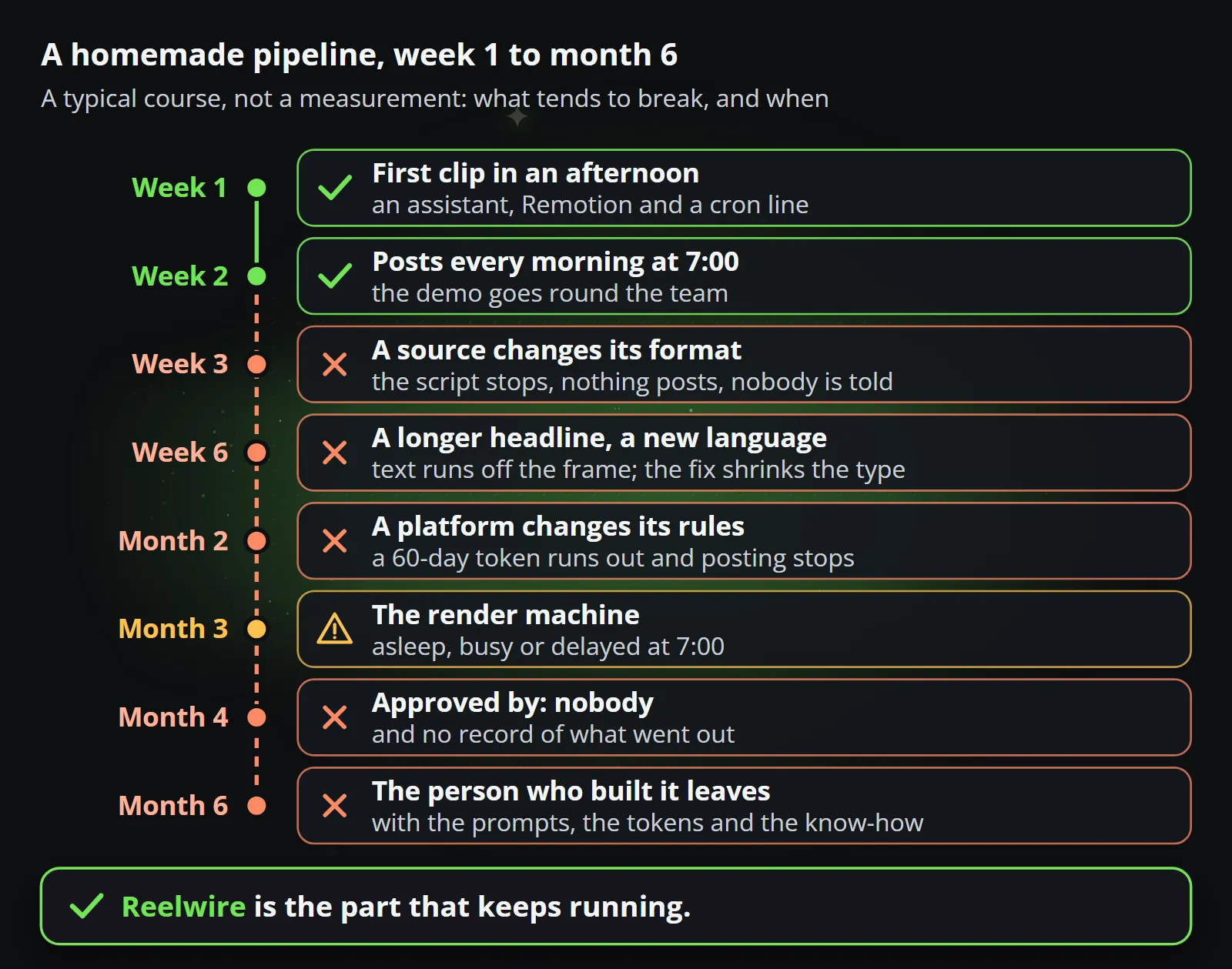
Week 3: a source changes, and nothing says so
The script reads a page or an API that somebody else runs. One morning a field is renamed, a number arrives as text, a free tier starts answering “too many requests”, or the page being scraped gets a new layout. The script throws, the scheduled task exits, and the log it writes to is one nobody reads. The first sign is a quiet channel, or worse, a clip that went out with an empty figure because the parser did not throw at all.
The fix is a prompt away, and that is the trap: fixing is quick, but somebody has to notice first, and that somebody is now on call for every source in the pipeline for as long as it runs.
Week 6: the layout drifts
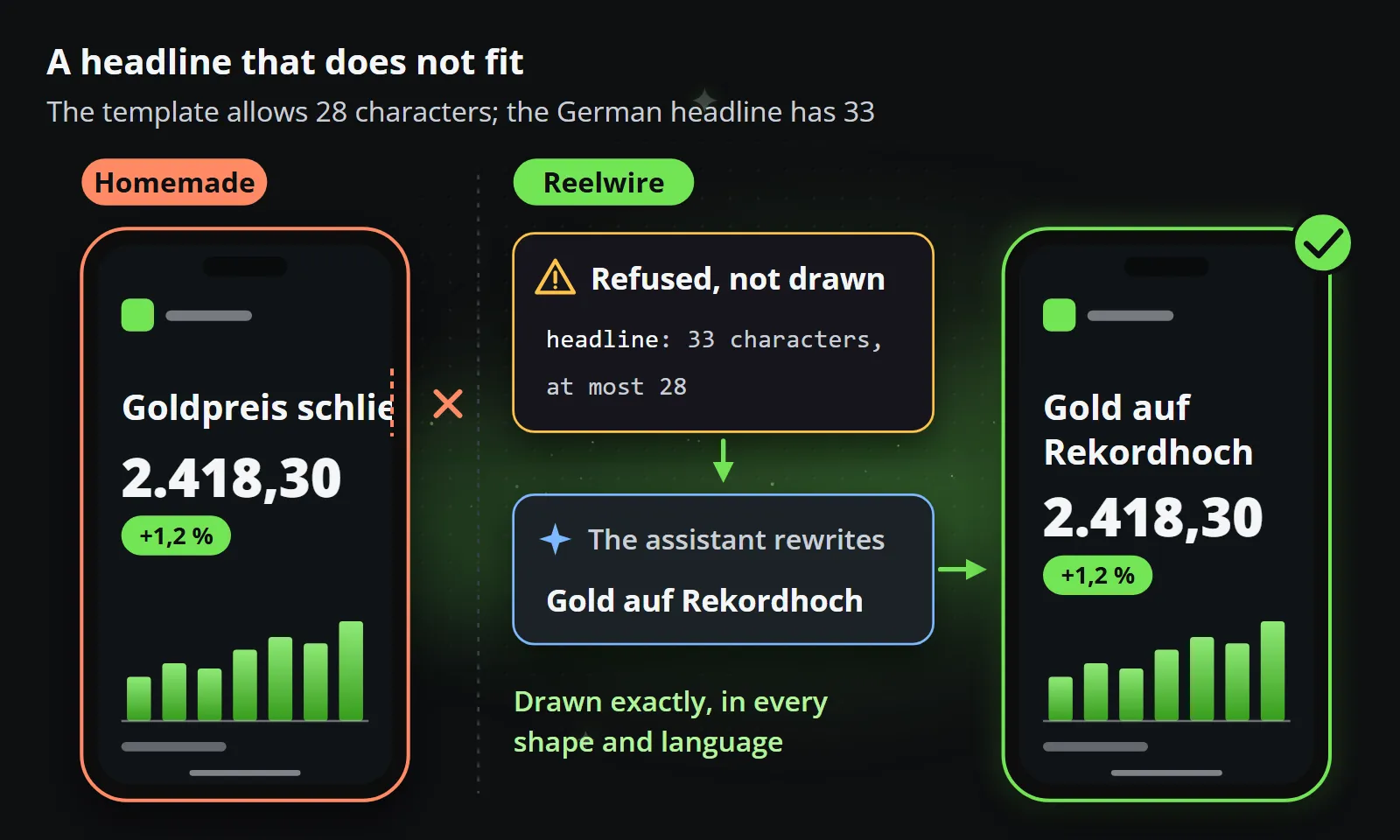
The composition was written for the first week’s headlines. Then a headline runs longer, a German version is wanted, and somebody asks for 4:5 for the Instagram feed. The text runs off the frame, and the quickest fix, asking the assistant to make it fit, shrinks the type or moves the logo. Every fix is reasonable on its own. Six of them later, no two months of the channel look alike, which is how most brand drift starts (the 500th clip shows where).
Each shape is another layout to keep: 9:16, 4:5, 1:1, 16:9 and 2:3 make five, and every language multiplies the lines that have to fit (one composition, every aspect ratio explains why). Say a template allows 28 characters for the headline and the German one has 33. A homemade build draws it anyway, off the edge. Reelwire refuses it before rendering, naming the field and the limit, and an assistant writes a shorter one.
Month 2: a platform changes the rules
Posting is the part that changes on somebody else’s timetable. Three examples from the platforms’ own developer pages, checked on 16 October 2026:
| Platform | The rule | What it means for a homemade pipeline |
|---|---|---|
| Access tokens last 60 days by default. Refresh tokens are for approved Marketing Developer Platform partners, and even those end after a year | Somebody signs in again every two months, or posting stops | |
| TikTok | Everything an unaudited app posts through the Content Posting API is restricted to private viewing until the app passes an audit | The clips post, and nobody sees them |
| Meta (Facebook, Instagram) | Each Graph API version works for at least two years, and stops two years after the next one is released | The code moves forward on Meta’s schedule, not yours |
Sources: LinkedIn, TikTok, Meta.
None of these rules is unreasonable, and each is one more date in the year when the pipeline needs a person.
Month 3: the render machine
Remotion draws every frame in a headless Chromium, which wants a machine that is switched on at seven with the memory to render video. A laptop that is asleep renders nothing. A hosted runner works until the clips get longer, the shapes and languages multiply, or the runner is busy: GitHub’s own documentation says a scheduled workflow can be delayed at times of high load, that some queued jobs may be dropped when the load is high enough, and that in a public repository a scheduled workflow is switched off after 60 days without activity (GitHub Docs, checked on 16 October 2026). A pipeline that works is precisely the one nobody touches for 60 days.
Month 4: nobody approved anything
A cron job has no approval step, so the first person to check a post is its audience. That is fine for a weather clip and not fine for a price, a rate, an offer, or anything a client, a manager or a supervisor may ask about later. And when the question comes, “who approved this, and what exactly went out on 3 March?”, the clip was rendered to a temporary folder, the caption lived in a variable, and the answer is a search through logs, if there are any.
Adding approval to a homemade pipeline means notifications, rights, a place to press Approve, a note of who did, and a way to hold back an update to a post that already went out. That is a product of its own.
Month 6: the person who built it leaves
The pipeline lives in one person’s repository, behind one person’s tokens, explained in one person’s chat history with the assistant. When that person changes team or company, the channel keeps running exactly until the next item on this list happens, and then it stops for good. The assistant can read the code; it cannot say why the 4:5 layout has a special case for Tuesdays.
Six months, side by side
| What happens | The assistant’s build | Reelwire |
|---|---|---|
| A source changes its format or its limits | The script stops; somebody notices, prompts a fix, redeploys | Ready-made feeds are Reelwire’s to keep working, fixed once for every workspace listening; your own events that do not fit are refused by name |
| A longer headline, a new language or shape | Text runs off the frame, or a fix shrinks the type | Every field checked against the template; an over-long one is refused by name before rendering |
| A platform changes its API or tokens | Your code, your app review, your token calendar | Email with a post kit, a signed webhook, or a connector for Discord, LinkedIn, Slack and Telegram, kept up to date once for everybody |
| The render | Your machine, awake at seven | Reelwire’s machines |
| A delivery fails | A line in a log | Retried; a post that still fails reads Failed on the Posts screen and can be sent again |
| Approval | Built by you, or nobody | From Small business, a person approves before a post goes out, on the channels that ask for it |
| A record of what went out | Whatever the logs kept | On Enterprise, every hand-over sealed with the video’s fingerprint, texts and approvers, kept ten years |
| The builder leaves | The knowledge leaves too | The set-up is on screens, not in one person’s code |
Reelwire is the part that keeps running
Reelwire takes the parts of that list that change underneath you and makes them its own job:
- The data. Ready-made feeds are fetched from public sources on the schedule each one states, and when a source changes its format or its limits, fixing it is Reelwire’s work, done once for every workspace that listens. Your own data arrives at a custom feed over the REST API, held to the template’s fields, and the same event sent twice makes one post. Data to video shows the three ways in.
- The layout. A template is designed once for every shape and wears your brand: logo, colours and fonts. Every field is checked against its limit, so an over-long headline is refused with its name rather than drawn off the edge, and every clip records the template version, brand and event it came from, so last quarter’s clip can still be explained.
- The render. Clips are rendered on Reelwire’s own machines. Nothing on your side has to be awake at seven.
- The hand-over. A due post goes out by email with a post kit, by a signed webhook to your own system or a posting service, or straight to Discord, LinkedIn (a personal profile), Slack or Telegram. Each way out is written down in the same step that moves the posts, so a crash loses nothing, and a failed call is tried again. Nothing makes LinkedIn’s 60 days go away: the LinkedIn connector takes a token that lasts that long, and, given its expiry date, it writes to you a week and a day before it runs out. From event to post walks through every step.
- Approval and the record. From the Small business plan, a person approves each post on a channel that asks for it, and an update of a post that already went out waits for approval too. On Enterprise nobody approves their own post, a channel can ask for two approvers, and every hand-over is sealed in a record with the video’s fingerprint, its exact texts and who approved it, time-stamped every day by an independent authority, kept ten years and checkable without Reelwire.
Most of this is not clever. It is the dull, permanent work of a channel that runs every day, done once for everybody instead of once per repository.
Does the assistant still have a job?
Yes, and a better one. The parts of a channel that need judgement are exactly what an assistant is good at: is this worth a post, which angle, how to say it in nine words, which channels and languages, and when. The parts that must be exact, the figure, the layout, the logo, the legal line and the hand-over, belong in a system that does not improvise. Letting an AI agent run your channel draws that line in detail.
Reelwire’s MCP server is where the two meet. Claude and ChatGPT
connect by signing in at https://mcp.reelwire.io/mcp; coding agents such as Claude Code connect with
a key whose permissions you choose, and most of them can sign in too. The assistant then sets up channels, writes and schedules posts,
and explains what went out and why one failed, with the rights it was given and no more: it never
creates keys or touches billing, and it approves posts only when the person who connected it holds
that right and allowed it. When a headline does not fit, the refusal names the field and the limit,
and the assistant rewrites it.
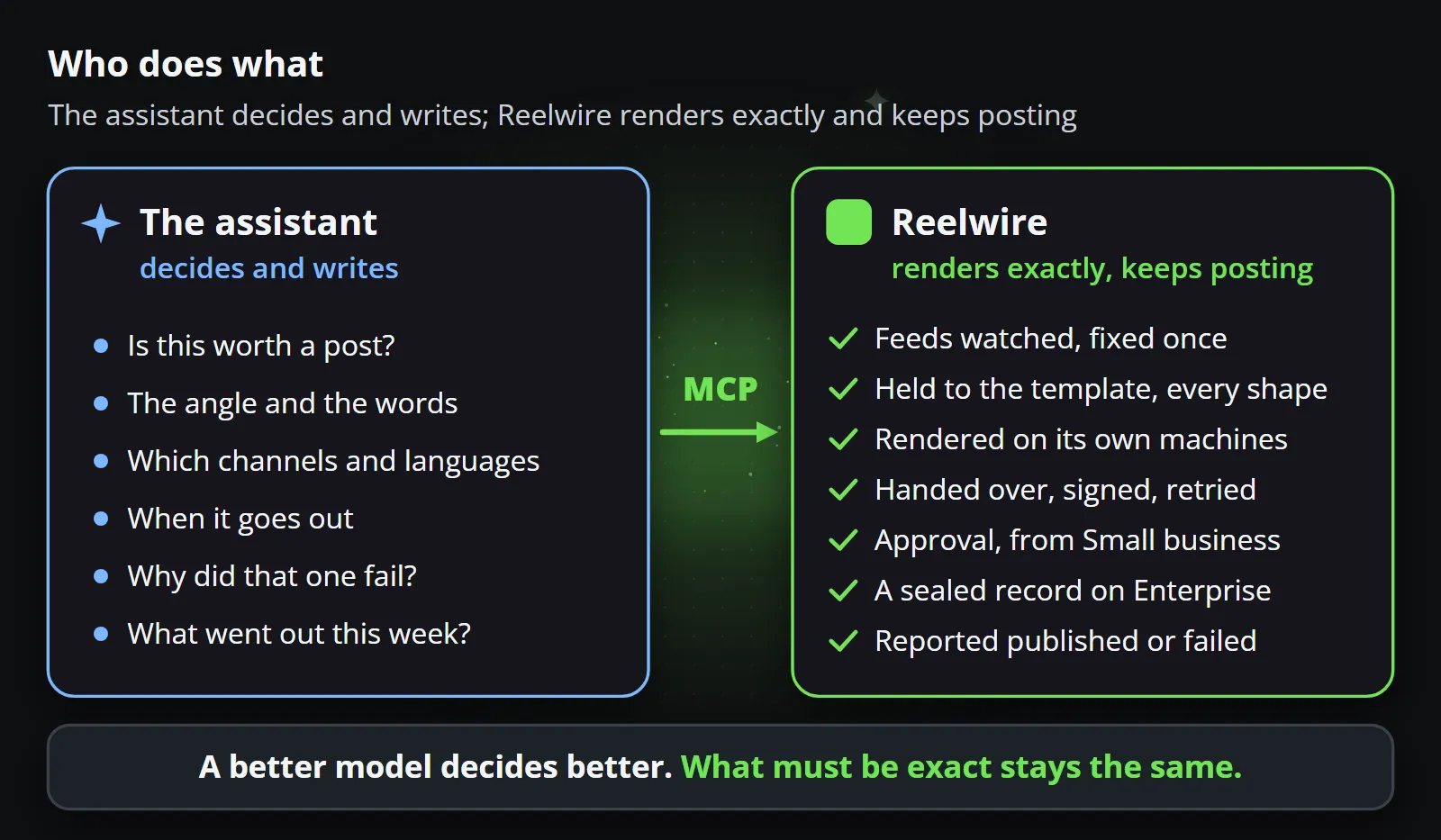
This is also why a better model makes the set-up better rather than replacing it. In a homemade pipeline, a new model is a reason to regenerate code that was working. Connected to Reelwire, a new model simply makes better decisions about what to post and how to say it, while the templates, the feeds, the approvals and the record stay as they were. And a coding agent still has code to write: the few lines that send your own system’s events to a custom feed, which the developer page shows.
When building it yourself is the right call
For some teams the build is the better answer, and it is worth saying which:
- Video is a feature of your own product. Your users press a button and get a video, so the render belongs inside your software. Rendering APIs compared looks at the services built for that.
- It is a one-off. A launch week, a conference, a test of an idea: something that does not need to run in six months.
- Every frame is bespoke. You want motion no template has, and a person looks at every clip anyway.
- An engineer owns it, on purpose. Somebody’s job includes the pipeline, the sources, the tokens and the render at seven, and that time is budgeted.
If none of those describes you, the build is not the expensive part. Owning it is.
Bottom line
An assistant with Remotion and a scheduled task builds a convincing first clip in an afternoon, and that is worth doing once, if only to see it work. A channel is something else: the same job every day for a year, while sources, layouts, platforms and people change around it. Let the assistant do what it is best at, deciding and writing, and let Reelwire be the part that keeps running.
Try it on your own data: Reelwire’s free plan makes 25 videos a month with no card, and how it works shows the whole chain. Then connect your assistant and give it the job it is good at.
Frequently asked questions
Can Claude Code build a video automation with Remotion?
Yes. Remotion is a framework for making videos with React, and its makers publish Agent Skills that teach coding agents such as Claude Code, Codex and Cursor how to work in a Remotion project. With a data source and a scheduled task, a first automated clip is an afternoon's work. Keeping it running for a year is the larger job.
Why not just have my AI assistant build my video pipeline?
You can, and for a prototype, a one-off or video inside your own product it may be the right choice. For a channel that posts every day, the build is the smaller part: sources change, layouts outgrow their text, platforms change their rules, and somebody has to approve posts and keep a record. That ongoing work is what Reelwire does.
What breaks first in a homemade video pipeline?
Usually the data. A source changes its format or starts limiting requests, the script stops, and since nobody reads a scheduled task's log, the first sign is a missing post or a wrong figure. Longer headlines and new languages come next, then platform tokens and API versions.
Is Reelwire built on Remotion?
Its templates are Remotion projects, rendered on Reelwire's own machines. The difference from a homemade build is not the library but everything around it: feeds that are looked after, templates held to their data in every shape, signed and retried hand-overs, approval and a record.
Can my AI assistant work with Reelwire instead of replacing it?
Yes. Claude, ChatGPT and coding agents connect to Reelwire's MCP server at https://mcp.reelwire.io/mcp, and can set up channels, write and schedule posts and explain what went out, within the permissions you give them. The assistant decides and writes; Reelwire renders and hands over.
Do I need a Remotion licence to automate videos?
According to Remotion's licence, checked on 16 October 2026, it is free for individuals, companies of up to three employees, non-profits and evaluation; a larger company needs a paid company licence, priced per seat or per render. Check Remotion's own pages for the current terms.

Co-founder of Reelwire. Every organisation has facts worth showing, its prices, results, releases and warnings, and the vision is that every one of them can show those facts every day, on brand, in every format and language, without a production team behind each post. Your data, in motion: correct, recognisable and consistent from the first clip to the thousandth.