Your Thousandth Clip Should Look Like Your First: Brand Consistency at Volume
Consistency is the production quality that compounds, and the first a busy team loses. Where brand drift starts in short video and how to prevent it.

Key takeaways
- Brand consistency is what builds recognition in a feed, and recognition is decided in a fraction of a second, before anybody reads a word.
- Drift never arrives as a decision. It arrives as many small, reasonable fixes made under time pressure by different people.
- A guideline describes the brand; a template enforces it. Type sizes, logo rules, safe areas and disclaimers belong in the composition, not in a PDF.
- Variety and consistency are not opposites: vary how a story is shown, never the frame it is shown in.
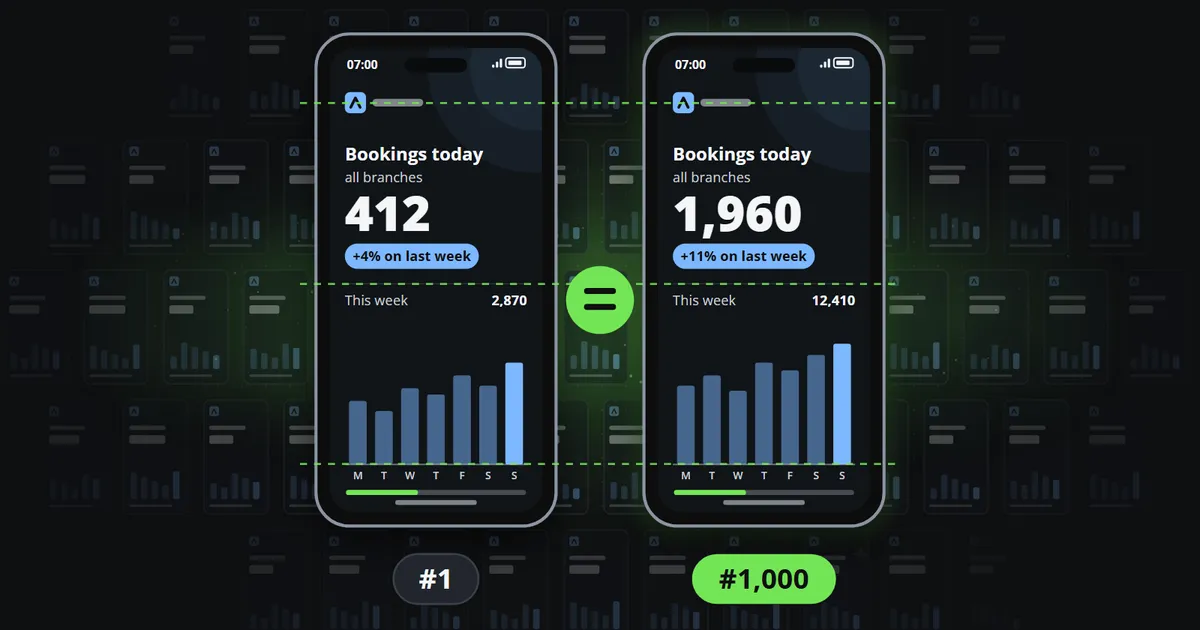
Everybody claims brand consistency. Almost nobody is tested on it, because almost nobody publishes enough to find out. Twelve videos a year can be made carefully by one person who cares. Three hundred a month cannot, at least not by hand. This article is about why consistency is the production quality that matters most once you publish at volume, where the drift comes from, and how to make your thousandth clip look like your first.
Recognition is decided before anybody reads
Somebody scrolling a feed at speed is not reading your headline. In a fraction of a second, without knowing they are deciding, they work out whether this is something they have seen before. If it is, and they liked it then, they stop. If it is not, they scroll on.
That is what brand consistency buys: not elegance, recognition. And recognition compounds. Every consistent post makes the next one easier to recognise. Every inconsistent post starts from zero, however good it is.
A thousand clips that look like one company beat a thousand good clips that look like a thousand companies.
Where the drift starts
Drift never announces itself. It arrives as a reasonable decision made under time pressure:
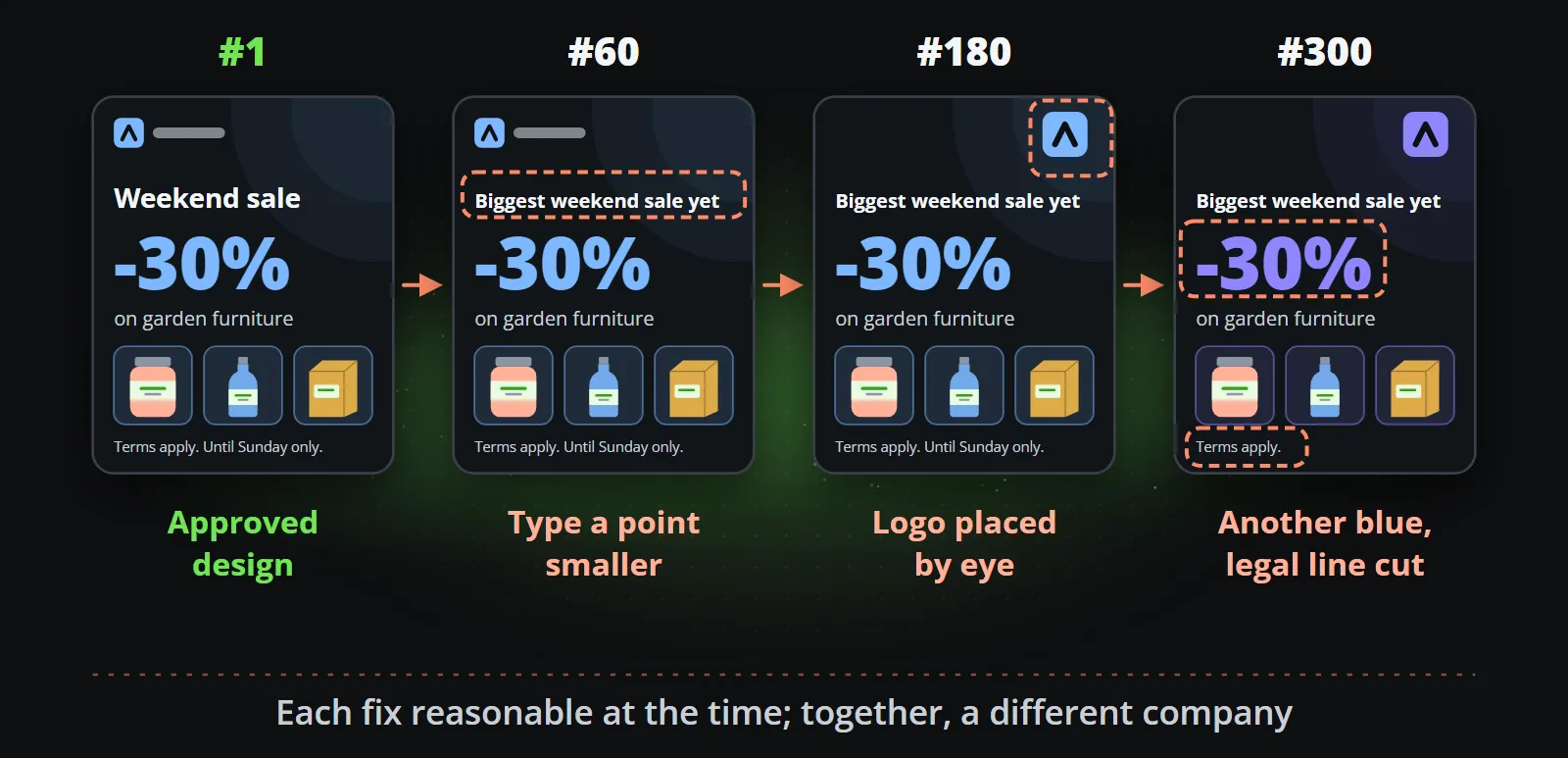
- A headline runs two words long, so the type drops a point. Nobody notices.
- A logo is placed by eye on a vertical cut, because the horizontal one was the master.
- A second designer joins and uses the brand blue from a slide deck rather than the one in the manual.
- An urgent clip skips review, and the format it improvised becomes the format nobody corrected.
- A disclaimer is shortened once because it did not fit, and the short version spreads.
- A new language is added, and its longer words quietly change the layout.
None of these is a mistake. Each one is a person solving the problem in front of them. Together they are the reason a channel’s hundredth post looks like a different company from its first.
Laid side by side, the drift is easy to see. No single clip looks wrong, and yet the three-hundredth no longer looks like it came from the same company as the first.
A guideline describes; a template enforces
Most brands answer drift with a guideline: a PDF of colours, type sizes and logo rules. Guidelines are useful and they do not work at volume, for a simple reason. A guideline has to be remembered, every time, by every person, under time pressure. The more posts, people, shapes and languages there are, the more places it can be forgotten.
A template is a guideline that cannot be forgotten. It is a decision written down once, in a form the machine enforces:
| Brand rule | In a guideline | In a template |
|---|---|---|
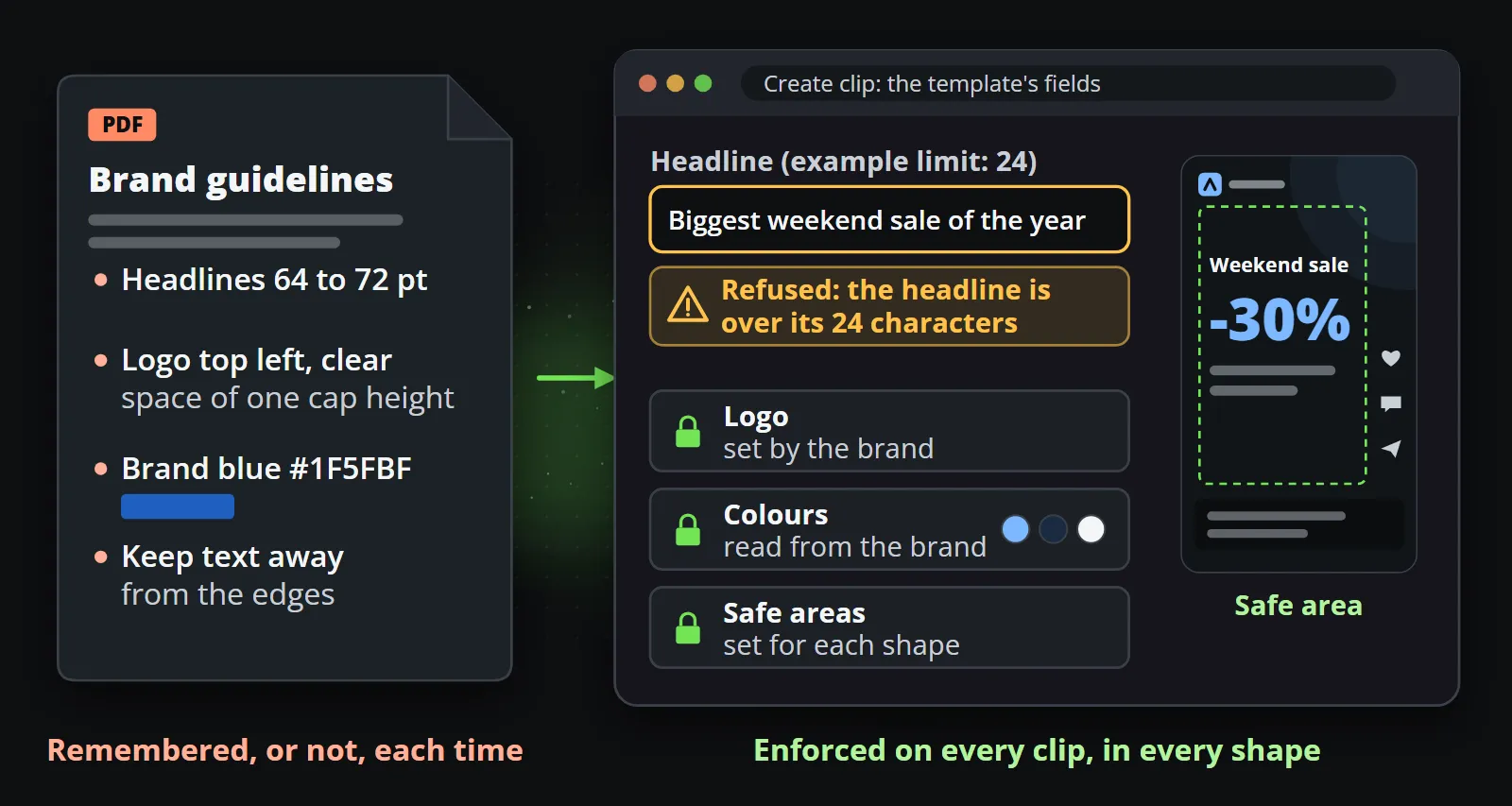
| Type size | “Headlines 64 to 72 pt” | Set from the frame; a headline that does not fit is refused, not shrunk |
| Logo | “Top left, clear space of one cap height” | Positioned by a rule that holds in every aspect ratio |
| Colours | “Brand blue #1F5FBF” | Read from the brand record, never typed by hand |
| Safe areas | “Keep text away from the edges” | Declared per shape, so nothing sits under a platform’s buttons |
| Disclaimer | “Must appear on every post” | A field the template always draws, at a legible size |
| Motion | “Calm, confident” | The same animation curves in every clip |
This is not an argument that machines have taste. It is an argument that taste belongs at the point where the template is designed, and nowhere after.
In practice the difference looks like this: the guideline asks a person to remember each rule, and the template simply refuses whatever breaks one.
Consistency makes approval possible
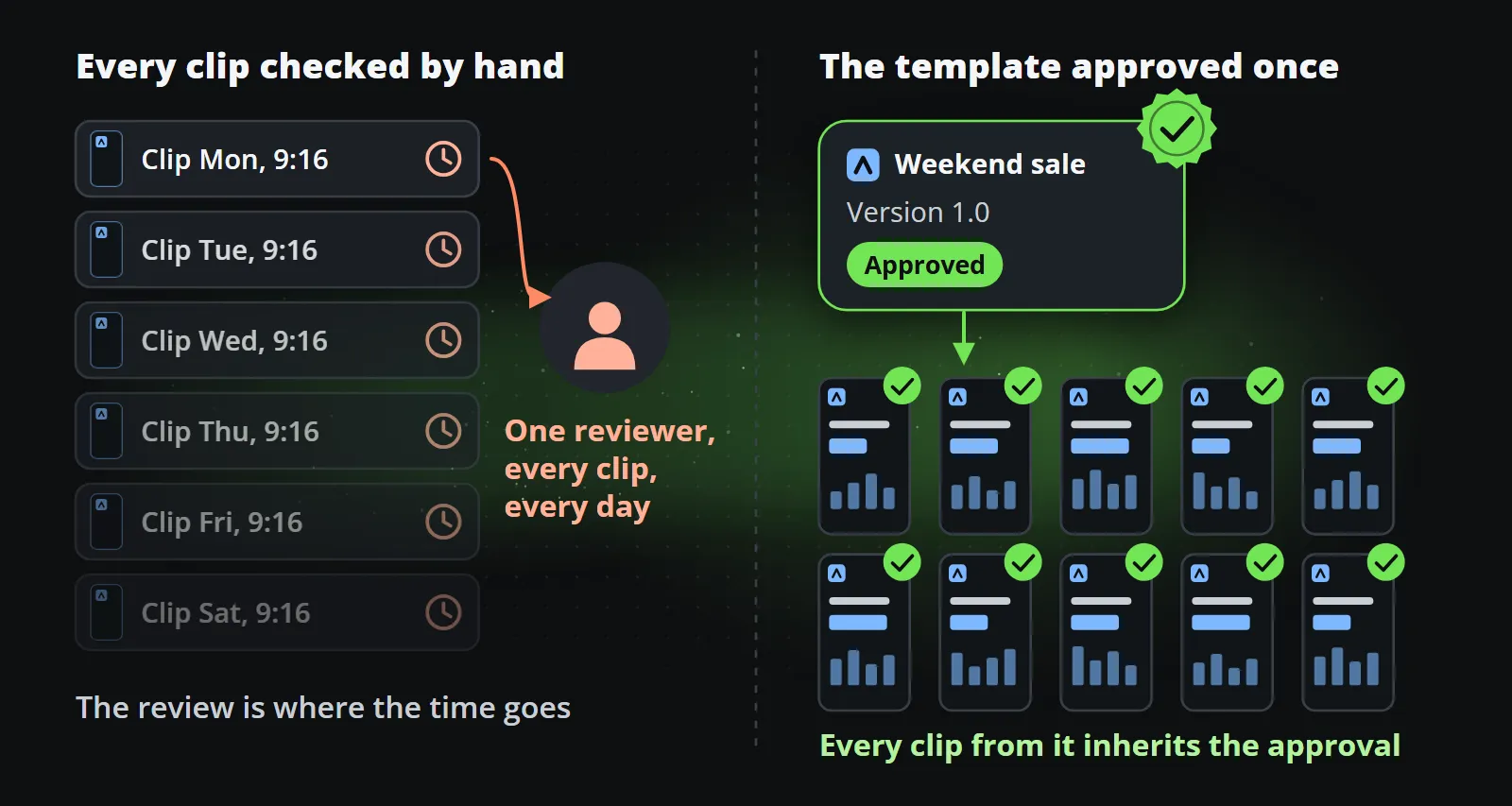
There is a second reason consistency matters, and it is about people rather than viewers. If every clip can come out differently, every clip has to be checked before it goes out. That review is where the time goes, and where a busy week turns into skipped posts.
When the composition is fixed and the content is the only thing that changes, the output is predictable: identical data produces an identical clip, every time. So a reviewer can approve the template once and trust every clip made from it. Reelwire works this way, with an optional check per post for the channels that need one. It is also why generated video struggles here: a model gives a different result each time, so its clips can never be approved in advance. What generative video still cannot do explains why.
The review moves from the end of the line, where it has to happen hundreds of times, to the start, where it happens once.
What belongs in a brand record
If the brand is going to live in the system rather than in a document, the system needs a complete record of it. A useful brand record for video holds:
- The marks: the logo in its variants, and a badge or presenter mark if you use one.
- The palette: the colours, with which one is for text, which for backgrounds and which for highlights, so contrast is decided once.
- The type: the typefaces for headlines and body, and the sizes they may range between.
- The surroundings: a background picture or texture, an intro and an outro.
- The sound: a soundtrack or sound logo, if the brand has one.
- The words that never change: the legal line, the call to action, the web address.
Reelwire keeps exactly this as a brand, and every template reads from it. Change the logo there, and the next clip on every channel wears the new one; nobody has to hunt through last month’s files.
Variety without drift
Consistency does not mean every post looks the same. A channel that shows the same layout every day becomes wallpaper. The trick is to separate two kinds of change:
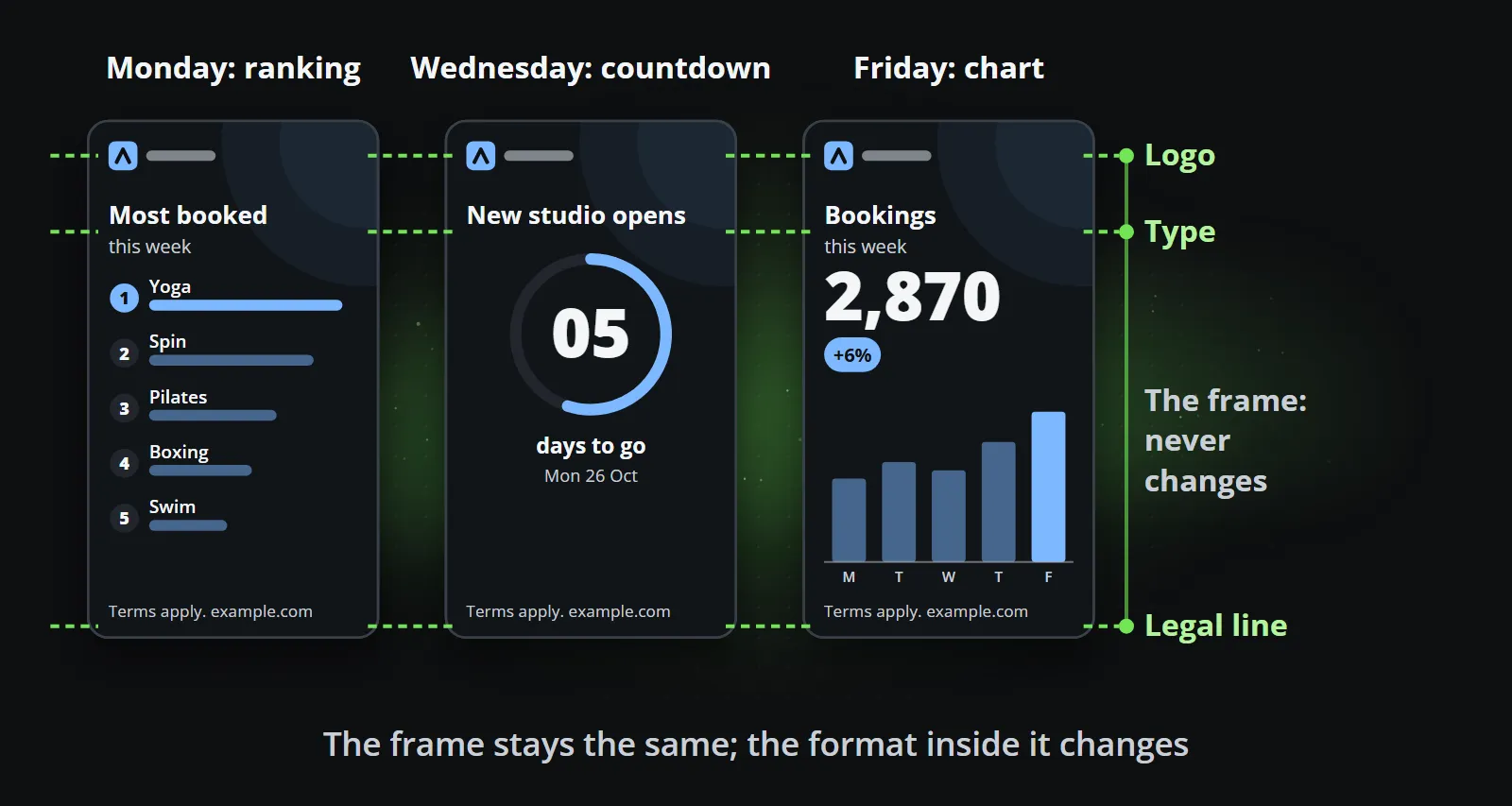
- What must never change: the logo, the palette, the typefaces, the safe areas, the legal line, the tone. This is the frame.
- What should change: the format, a ranking today, a countdown tomorrow, a chart on Friday, and the visual style within the brand. This is the picture inside the frame.
Reelwire’s templates are built along that line. Each is a format, rankings, countdowns, charts, offer cards, agendas and more, and each comes in several styles, all wearing the same brand. Consecutive posts look different; every one of them looks like you.
Put three days of such a channel next to each other and the line between the frame and the picture is visible at a glance.
A consistency check for your own channel
Put your last twenty posts side by side and ask:
- Is the logo in the same place, at the same size, in every one?
- Could you tell they are yours with the logo covered?
- Are the type sizes the same for the same kind of text?
- Do the vertical and square versions look like the same post?
- Is every required legal line present, and legible?
If the answers are mixed, the problem is rarely the people. It is that the brand lives in a document instead of in the thing that makes the posts. Moving it there is the first step; one composition, every aspect ratio covers the shapes, and the free plan lets you see your own brand on a month of templated posts.
Frequently asked questions
Why is brand consistency important on social media?
Because people scroll fast and decide in a fraction of a second whether a post is from somebody they recognise. A consistent look, colours, type, logo position and recurring formats, builds that recognition over hundreds of posts; inconsistent posts each start from zero.
How do you keep video branding consistent across a team?
Move the brand rules from a guideline into templates. When type sizes, colours, logo placement, safe areas and disclaimers are properties of the composition, nobody has to remember them and nobody can drift from them under time pressure.
Does brand consistency make content repetitive?
It does not have to. Keep the frame constant, colours, type, logo and tone, and vary the format: rankings, countdowns, charts, cards and different visual styles within the brand. Viewers notice that today's post differs from yesterday's; they also notice whose it is.
How many brand elements should a video template control?
Everything a viewer uses to recognise you: logo and its position, colour palette, typefaces and sizes, safe areas for each aspect ratio, motion style, sound, and any legal line. The content is the only thing that should change from clip to clip.
Make your first clips today
The free plan makes 15 clips a month and asks for no card. Add your logo and colours, pick a template, and see a finished clip in your own brand before you decide anything.

Co-founder of Reelwire. Every organisation has facts worth showing, its prices, results, releases and warnings, and the vision is that every one of them can show those facts every day, on brand, in every format and language, without a production team behind each post. On brand, every day: correct, recognisable and consistent from the first clip to the thousandth.