AI Slop: Why Generated Brand Videos Get Labelled, Demoted and Screenshotted
"Slop" was Merriam-Webster's word of 2025. What makes a brand video read as AI slop, how platforms label it, and how to post at volume without it.

Key takeaways
- AI slop is content that is cheap to make, generic, and visibly generated. Audiences have learnt to spot it within a second, mostly from wobbly geometry, wrong lettering and drifting logos.
- For a brand the risk is lopsided: a good generated clip earns no credit, a bad one gets screenshotted and shared.
- YouTube, TikTok and Meta now label synthetic media, and the EU AI Act adds disclosure duties for deepfakes from August 2026.
- Volume does not have to mean slop. A template designed by a person and filled with real data publishes daily without any generated pixels in it.
At the end of 2025 Merriam-Webster named “slop” its word of the year (checked on 14 October 2026), and everybody knew which slop it meant: the constant stream of cheap, generic, slightly wrong content made with generative AI. Since then, AI slop has become the reason a brand video made with a generator can do more harm than no video at all, and the reason platforms have started labelling what is generated.
This article is about what makes a brand video read as slop, what the platforms and regulators now do about generated media, and how to publish at the volume short-form video rewards without making any of it.
What AI slop actually is
AI slop is not “anything made with AI”. A good picture made with a model and checked by a person is just a picture. Slop is content where three things meet:
- It was cheap to make, so it was made in bulk.
- It is generic, because it was made from a prompt rather than from anything specific.
- It is visibly generated, because nobody fixed the parts models get wrong.
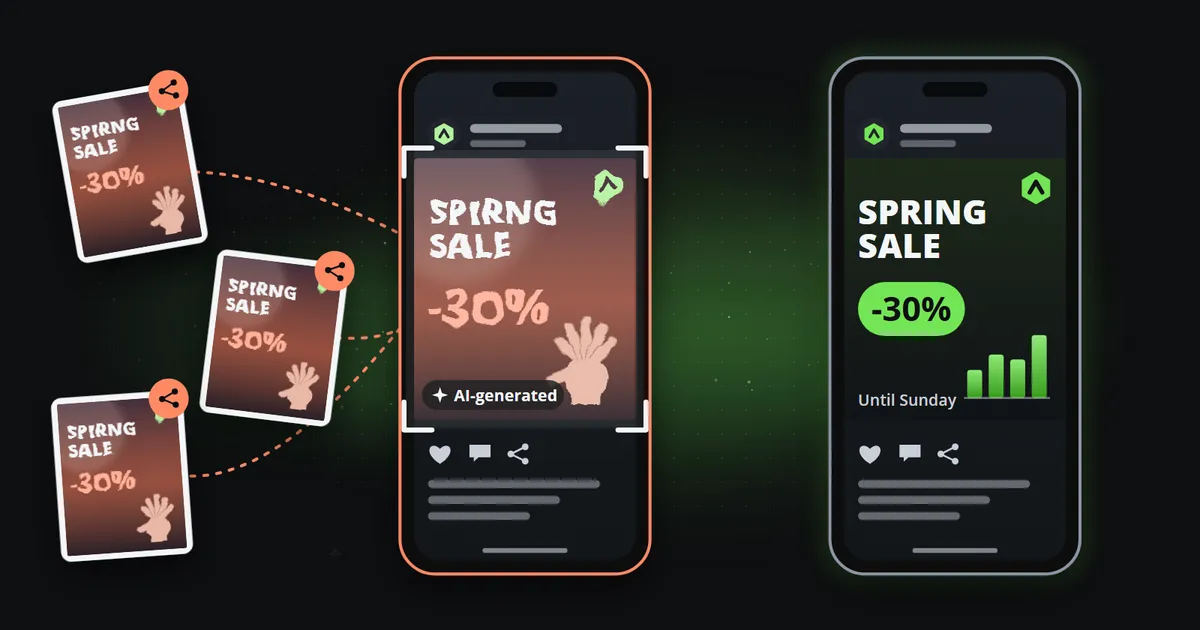
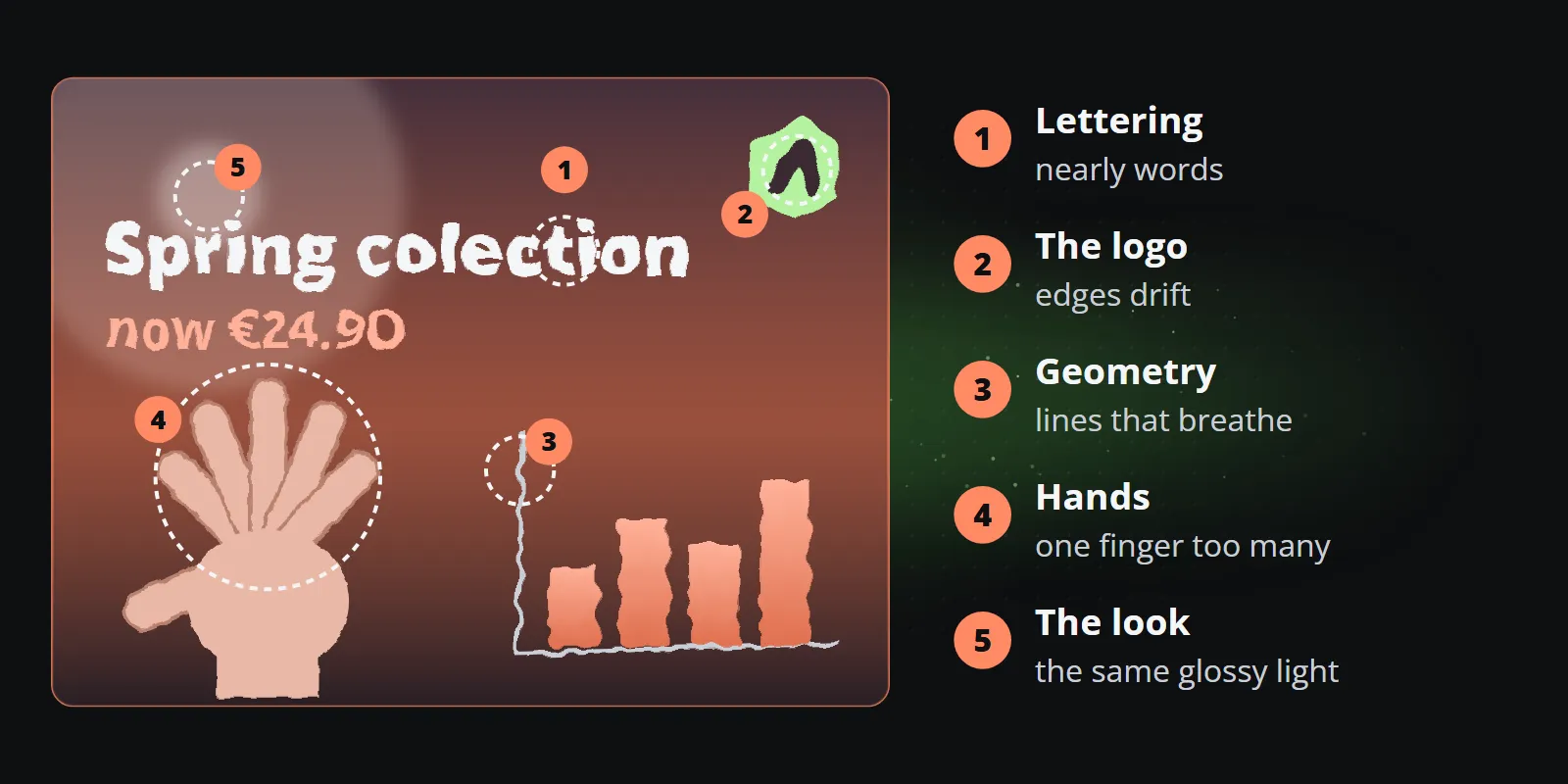
The third point is where brands get caught. Audiences have become very good at spotting generated video, and they do not need to think about it. The tells are almost always the same:
| The tell | What the viewer sees |
|---|---|
| Lettering | Words that are nearly words, or a number that changes between frames |
| The logo | Close to yours, but the spacing, edges or colour drift |
| Geometry | Lines, bars and frames that wobble or breathe |
| Hands and faces | Too many fingers, smooth skin, eyes that do not quite track |
| The look | The same glossy lighting and slow push-in as every other generated clip |
Every one of these appears in exactly the content a brand is most likely to publish: text, a logo, a chart, a person.
Why the risk is lopsided for a brand
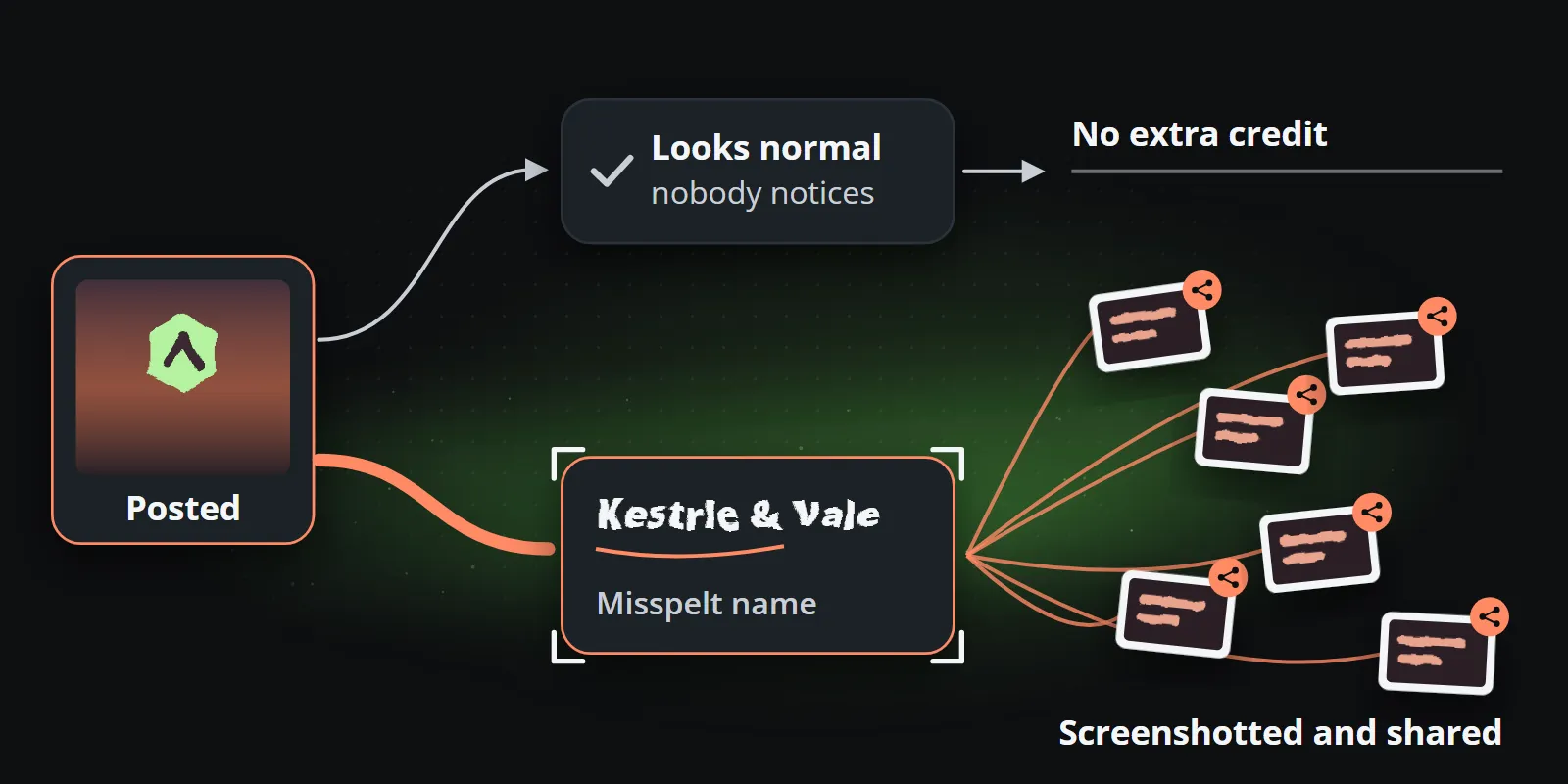
A good generated video earns nothing special. Nobody praises a clip for looking normal. A bad generated video, with a misspelt product name, a mangled logo or a chart that contradicts its own caption, gets screenshotted, and a screenshot travels further than the original ever did.
So the expected value of generated visuals depends on how much reputation you have to lose:
| Who | How much it matters |
|---|---|
| Banks, brokers, insurers | Very high. A generated chart implies data nobody sourced, which is a compliance question, not a design one |
| Engineering and industrial brands | Very high. An imprecise picture contradicts the precise product it is selling |
| Public bodies | High. A generated image of a real street is noticed by the first resident who lives there |
| Agencies | High. Rework on generated clips quietly eats the margin |
| A new startup with nothing to lose yet | Low. Speed often matters more |
This is not an argument against AI. It is an argument against using a probabilistic model for the parts of a post that have to be exact.
How platforms label generated media
The big platforms have moved from ignoring generated content to labelling it. Each policy below was checked on the platform’s own pages on 14 October 2026.
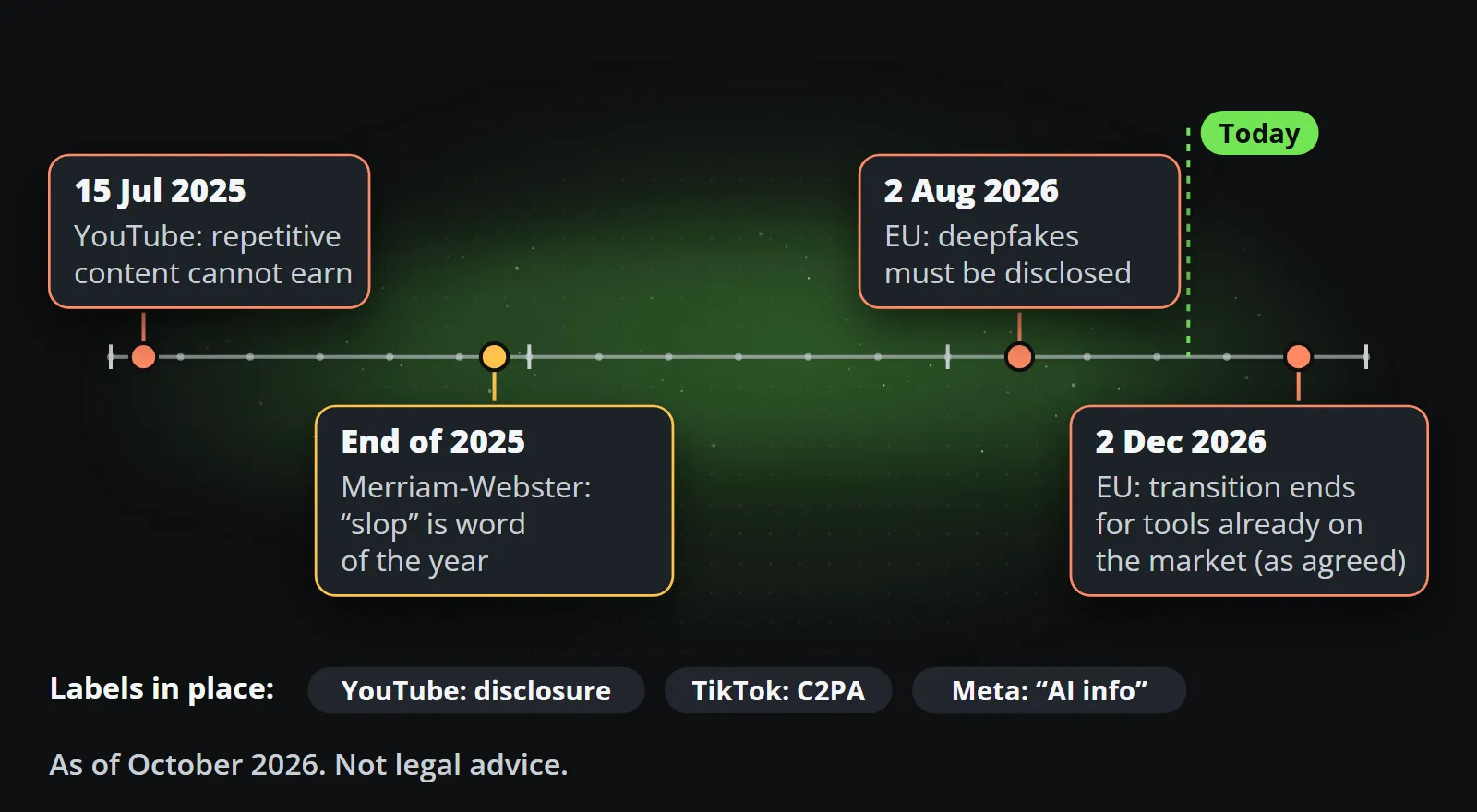
YouTube asks creators to disclose content that is realistic and was meaningfully altered or synthetically generated, and shows a label to viewers. Separately, since 15 July 2025 the YouTube Partner Program treats mass-produced, repetitive content with little original value as “inauthentic content” that cannot earn money. The rule is aimed at mass production rather than at any one tool: churning out interchangeable clips is the problem.
TikTok requires creators to label realistic AI-generated content and labels it automatically when the file carries Content Credentials, the C2PA metadata that many generation tools now attach.
Meta shows an “AI info” label on Facebook, Instagram and Threads posts it detects as made or edited with AI, partly by reading the C2PA and IPTC standards.
The labels are not penalties in themselves. But a label next to a brand’s post changes how people read it, and with the platforms pushing back on repetitive, low-effort content, slop can become a reach problem as well as a reputation problem.
What the EU AI Act adds
As of October 2026, Article 50 of the EU AI Act sets transparency duties for generated content. Two matter here:
- Providers of tools that generate images, audio or video must mark the output as artificially generated in a machine-readable way. For systems already on the market before 2 August 2026, the EU agreed a short transition to 2 December 2026, as the European Parliament’s briefing on the amending regulation sets out.
- Deployers, which includes a brand publishing the content, must disclose deepfakes: realistic generated or manipulated images, audio or video of people, places or events. That duty applies from 2 August 2026.
Both sources were checked on 14 October 2026.
What counts as a deepfake in a given marketing clip is a legal question, and this is not legal advice. The practical point is simpler: the more of a clip is generated, the more of it you may have to explain. Put on one line with the platforms’ own steps, the dates look like this:
Volume without slop
The reason brands reach for generators is real. Short-form platforms reward showing up often, and a team of two cannot hand-make a video every day. The answer is not to stop posting; it is to change what does the producing.
A template is a design made once by a person, with fields for the headline, the figure, the date, the logo and the picture. Data fills the fields, and every frame is drawn, not generated:
- the lettering is your typeface, set from the text,
- the logo is your file,
- the bar is exactly as tall as the value,
- the same data always produces the same clip.

That last property is what lets a template be approved once and trusted afterwards, which is what makes daily volume safe. Variety comes from choosing among templates and styles, not from letting a model improvise. AI video generator vs template video compares the two approaches on cost and accuracy.
Where AI still helps
None of this means keeping AI out of the building. It works well around the clip:
- Making assets once. A background picture, a short loop or a soundtrack can be generated once, checked by a person, and reused by every clip a template makes. Reelwire’s assistant does this with your own AI key.
- Writing and deciding. An assistant connected over MCP can pick the stories, write headlines that fit the template, and schedule posts, while the template keeps the result on brand. See MCP for video.
A quick self-check for your own channel
Look at your last ten posts and ask:
- Is there any lettering or number in them that a model drew rather than a font?
- Would your logo survive being paused on the worst frame?
- Could you reproduce any of them exactly if somebody asked where a figure came from?
- Does any of them look like it could have been posted by a different brand?
If the answers worry you, the fix is usually not to post less. It is to let templates carry the daily volume and keep generated footage for the moments that are meant to be cinematic.
Faceless videos for business shows what that daily volume can look like, and the free plan lets you try it on your own data.
Frequently asked questions
What does AI slop mean?
AI slop is low-effort content produced with generative AI in large quantities: generic, often inaccurate, and recognisably machine-made. Merriam-Webster chose "slop" as its word of the year for 2025.
Does YouTube label AI-generated videos?
YouTube requires creators to disclose realistic content that was altered or made synthetically, and shows a label on those videos. Since July 2025 its Partner Program also treats mass-produced, repetitive "inauthentic" content as ineligible for monetisation.
How does TikTok detect AI-generated content?
TikTok asks creators to label realistic AI-generated content and automatically labels content that carries Content Credentials (C2PA metadata), which many generation tools attach to the files they produce.
Do I have to label AI-generated video in the EU?
Under Article 50 of the EU AI Act, deployers must disclose deepfakes, meaning realistic generated or manipulated images, audio or video, from 2 August 2026. Providers of generation tools must also mark output as machine-generated. This is not legal advice; check your own case with a lawyer.
Is template-based video considered AI-generated?
No, not in the sense the labelling rules cover. A template is a design made by a person and filled with data, and its frames are drawn, not generated by a model. If you add a picture you generated yourself, that picture is generated media; the rest of the clip is not.

Co-founder of Reelwire. Every organisation has facts worth showing, its prices, results, releases and warnings, and the vision is that every one of them can show those facts every day, on brand, in every format and language, without a production team behind each post. Your data, in motion: correct, recognisable and consistent from the first clip to the thousandth.