The Digital Leaflet: Weekly Offers as Short Videos for Every Branch
You already print the weekly leaflet. Publish it too: a digital leaflet of short offer videos for every branch, made from the price data you already keep.

Key takeaways
- The weekly leaflet already has a budget, a deadline and a price plan behind it. Its delivery is getting harder: one of Germany's largest grocers stopped printing it in 2023, and Deutsche Post's national leaflet bundle ended in 2024.
- A digital leaflet is not a PDF of the printed one. It is one short video per offer or per week, built from the same price data, in every shape the social platforms use.
- Every branch gets its own prices from one template: the price plan already has a row per branch, and each branch's row becomes that branch's clip.
- When the offers are data, the posts are ready when the offers are. Nobody redraws a leaflet for Instagram on Monday morning.
Every week, a supermarket or a chain of shops decides its offers, prices them per branch, lays them out as a leaflet and pays to print and deliver it. The work behind it is real and already budgeted: the price plan, the pictures, the approvals. A digital leaflet, or digital flyer, takes the same work one step further. The offers you already decided go out as short videos for every branch, on the channels your customers actually look at, at the moment the offers start.
This article is about that step: why the printed leaflet reaches fewer households, what a digital leaflet should be and why a PDF of the printed pages falls short, and how one price plan becomes a weekly offer video for every branch without anybody redrawing anything.
Why is the printed leaflet losing reach?
The leaflet is one of the most measured pieces of retail marketing there is. It has a fixed slot in the week, a print run, a distribution area and a budget line. What has changed is how many households it still reaches, and how hard it is to get it there.
- One of Germany’s largest grocers stopped printing it. REWE announced on 27 July 2022 that it would stop printing and distributing its paper leaflet on 1 July 2023. According to REWE’s own article on the decision, it had been distributing around 25 million leaflets every week, and the offers moved to its app and other digital channels (checked on 14 October 2026).
- A national leaflet bundle ended. Deutsche Post ended Einkaufaktuell, its Saturday bundle of retailers’ leaflets, on 1 April 2024. It had gone to up to 18 million households, and the reasons given were falling advertising spend and higher costs for energy, paper and staff, as dpa-AFX reported on 3 July 2023 (checked on 14 October 2026).
- Some cities made the letterbox opt-in. Since 1 January 2018, Amsterdam only allows unaddressed advertising through letterboxes carrying a “yes” sticker. The number of households receiving it fell from nearly 210,000 to just over 80,000, according to the city’s figures as reported by NOS in September 2019, when a court upheld the rule (checked on 14 October 2026).
None of this means print is finished. It means the leaflet’s reach is no longer something to count on, while the work that feeds it, deciding and pricing the offers, still happens every week. That work is the valuable part, and it can be published more than once.
What is a digital leaflet?
The quickest digital leaflet is a PDF of the printed pages on the website. It costs nothing extra, but a page laid out for paper is awkward to read on a phone, and it waits for people to come looking for it. The more useful version is built for the places people actually spend time: a short video per week or per offer, in the shapes the platforms use, with the price large enough to read in a feed.
| Printed leaflet | PDF on the website | Digital leaflet as short video | |
|---|---|---|---|
| Where people see it | The letterbox | Only if they go looking | Social feeds, Stories, messaging channels |
| Reach per branch | A delivery area, shrinking | Visitors to one page | Every account the branch posts to |
| A price changes after the deadline | Reprint, or live with it | Re-export the whole file | Change the data, the next post shows it |
| Shapes | One | One | 9:16, 4:5, 1:1, 16:9 |
| Made from | The price plan, laid out by hand | The printed file | The price plan, directly |
The last row is the one that matters. A digital leaflet that somebody lays out again by hand every week is a second leaflet with a second deadline. One that is drawn from the price plan is just the same work, published again.
What goes into an offer card?
An offer video is a sequence of offer cards: one product at a time, each with its price, shown for a couple of seconds before the next. Reelwire’s weekly offers template takes one to eight offers per clip and makes the clip about two seconds longer for each, so a short list makes a short clip.
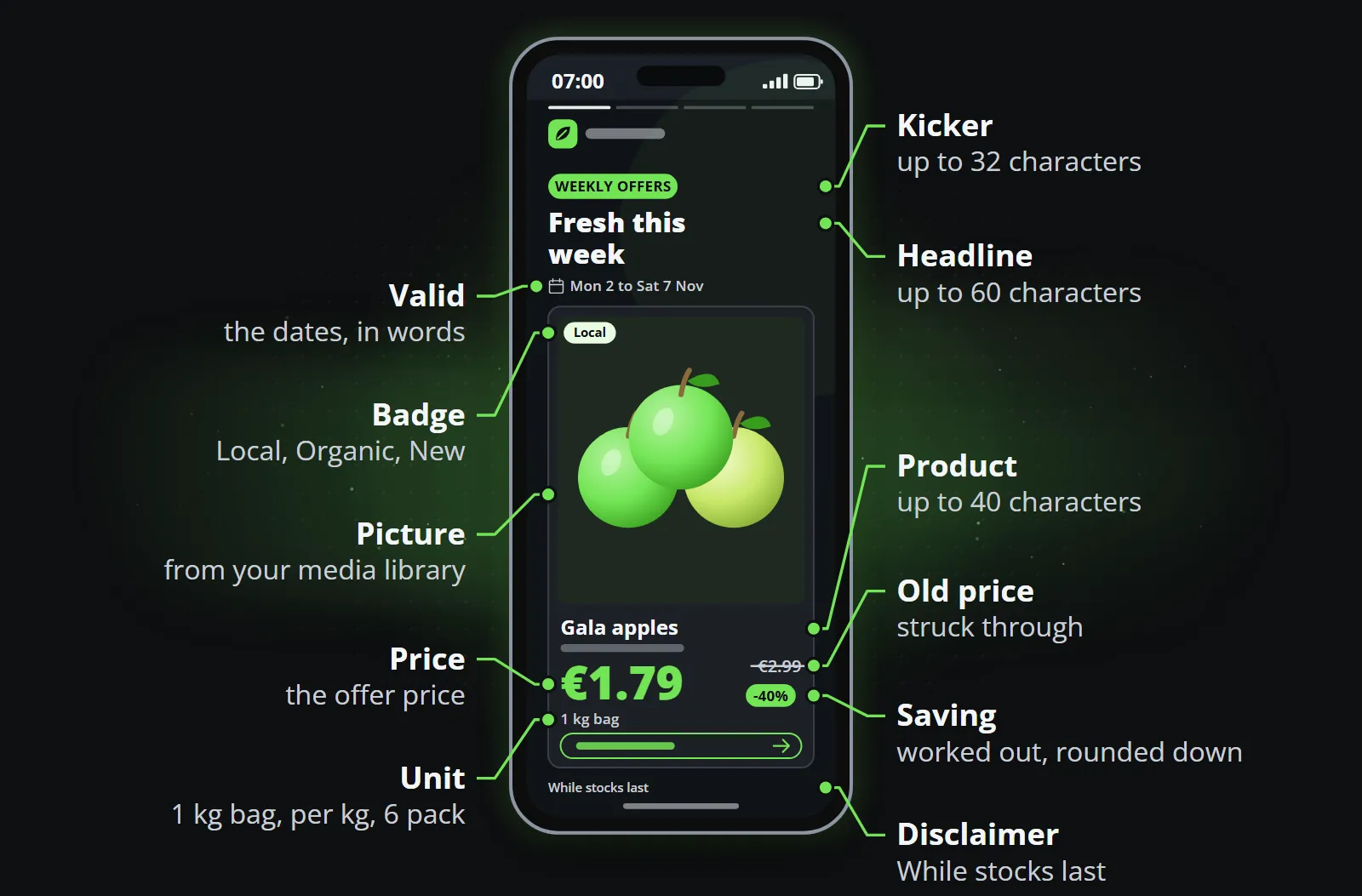
Every part is a field with a limit, and the limits are what keep the clip readable:
- Kicker and headline: up to 32 and 60 characters, such as “Weekly offers” and “Fresh this week”.
- Valid: when the offers run, written as people read it, such as “Mon 2 to Sat 7 Nov”.
- Product and detail: up to 40 and 60 characters, the name and where it comes from or what it is.
- Price and old price: the offer price, and the usual price struck through. The saving is worked out from the two and rounded down, so a clip never claims more than the prices say.
- Unit and badge: “1 kg bag”, “6 pack”, “Local”, “Organic”, “New”.
- Picture: a file from your media library. A web address is refused, so a clip never draws a picture nobody checked.
- Disclaimer: “While stocks last. Not all offers in every store.” Whatever the leaflet’s small print says, the clip can say too.
A headline that is too long is refused before anything renders, naming the field. That sounds strict, and it is the point: the alternative is a clipped word on a post that has already gone out.
How does every branch get its own prices?
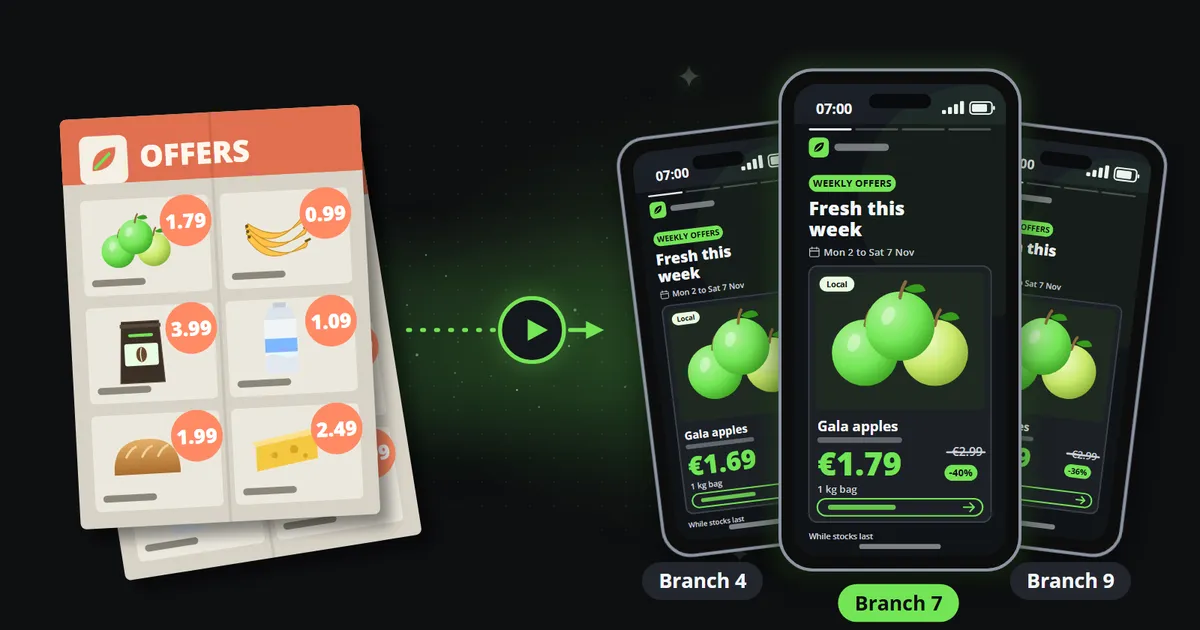
A chain rarely has one price for everything. A branch in a city centre and one on a retail park may price the same apples differently, and a regional promotion may run in only some of them. The printed leaflet handles that with regional editions. A digital leaflet handles it with data, because the price plan already has a row per branch.
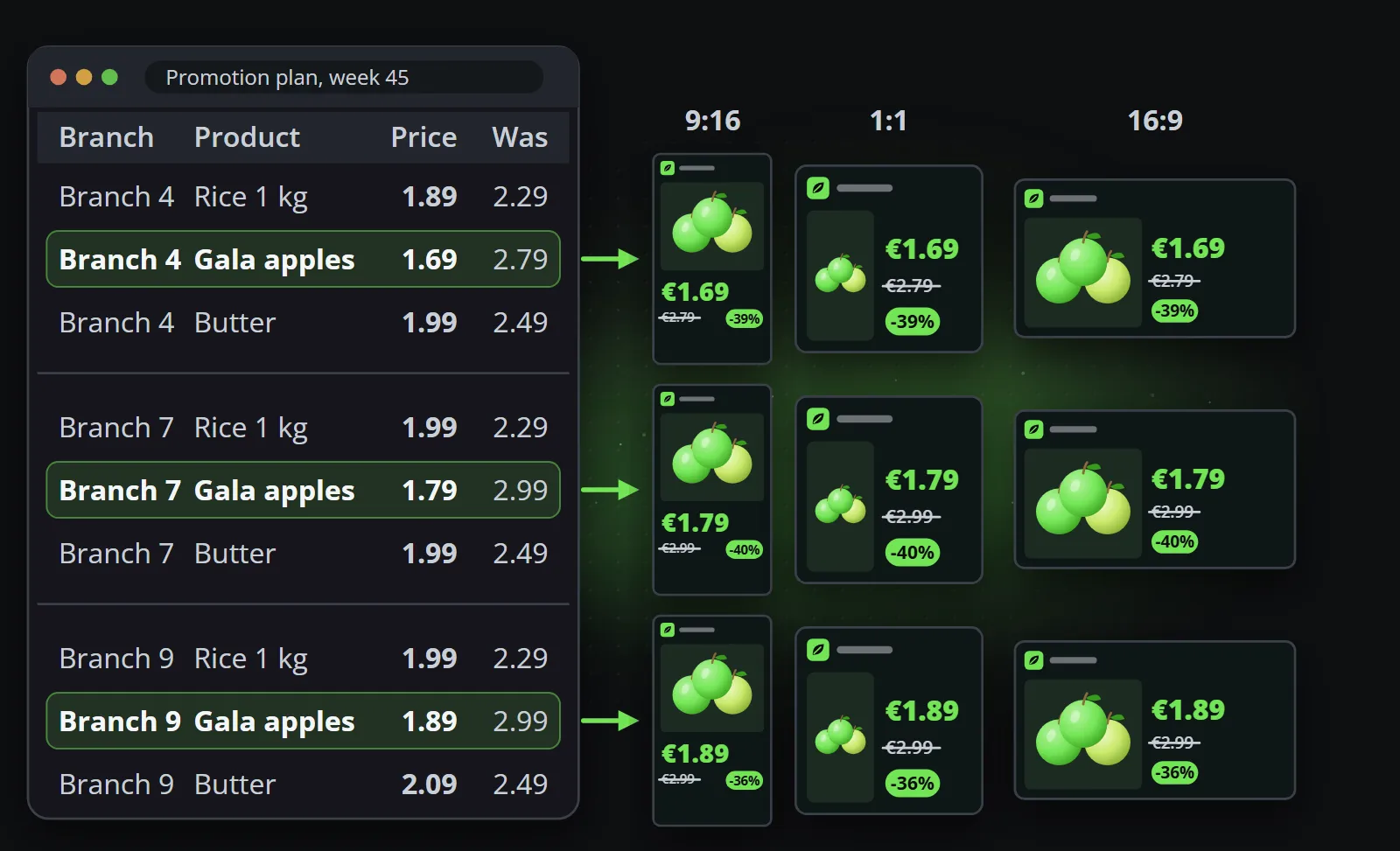
In the example above, the same apples cost €1.69 at Branch 4, €1.79 at Branch 7 and €1.89 at Branch 9. One template draws all three, and each branch’s clip shows its own price and its own saving: 39, 40 and 36 percent, each rounded down. In Reelwire, the setup looks like this:
- A brand carries the logo, colours, fonts and the presenter badge. A branch that needs its own address or opening line in the clip’s frame gets a duplicate of the brand with only those texts changed.
- A channel is one account in one shape: Branch 7 on Instagram in 9:16 is one channel, Branch 7 in the square feed is another. Each wears the brand and listens to its branch’s offers.
- A source per branch carries that branch’s offers: a post list in the dashboard, or a custom feed your own system sends events to.
Because every clip comes from the same template, a change to the design reaches every branch at once, and none of them drifts into its own version of the brand.
Where does the data come from?
From wherever the price plan already lives. In most retail groups that is a merchandise or pricing system, sometimes a spreadsheet the marketing team keeps, and the leaflet is laid out from an export of it. The same export can feed the digital leaflet, in one of two ways:
- Typed or pasted into a post list. In Reelwire’s post composer, a person fills in the week’s offers once and schedules the post for Monday at 07:00. Every channel listening to the list makes its own clip. This needs no developer and is the right way to try it.
- Sent by your own system. A small script reads the confirmed plan and sends one event per branch over the API, to a custom feed. The dashboard writes the code for it in Node.js, Python, PHP, C# or curl, and its test tool sends a first event before your system sends anything.
Either way, the content is checked against the template when it arrives, not when it renders on Monday morning. Data to video explains the sources in more detail.
What does a week look like?
Here is one way a three-branch group could run its digital leaflet in the first week of November 2026, as it shows up in Reelwire’s posting calendar. Each post is nine clips: three branches in three shapes.
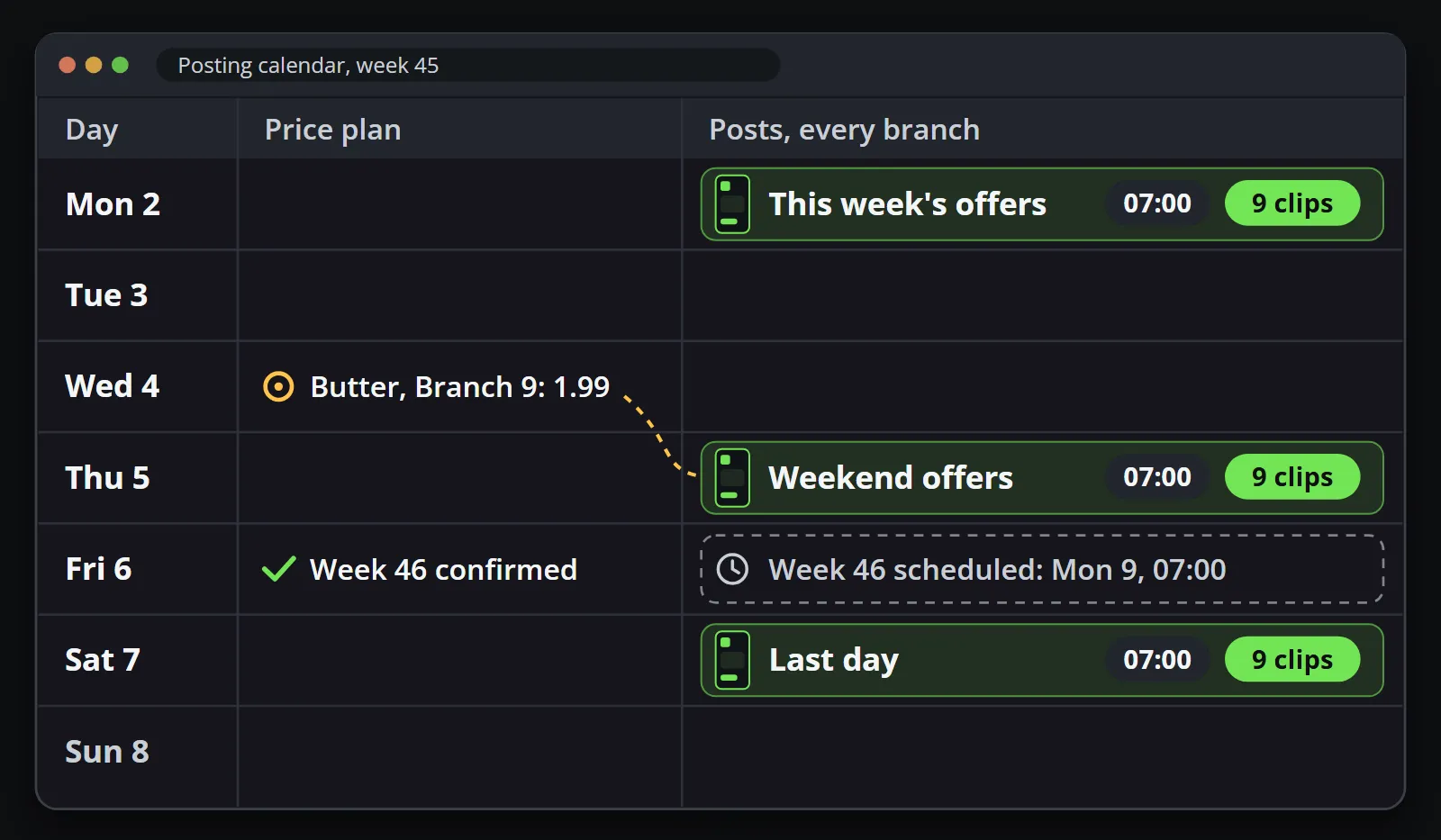
- Monday, 07:00: the week’s offers go out for every branch, in every shape, the moment they start.
- Wednesday: the price of butter at Branch 9 changes to €1.99 in the plan. Thursday’s post is still waiting in the post list, and a waiting post can be changed until it goes out, by hand or by your system, so the weekend offers show the new price. A printed leaflet would have kept the old one all week.
- Thursday, 07:00: the weekend offers, a shorter list.
- Friday: next week’s plan is confirmed and scheduled for the following Monday at 07:00. Nobody has to be at a desk on Monday morning.
- Saturday, 07:00: a last-day post for the offers that end tonight.
This is the whole idea in one sentence: when the offers are data, the posts are ready when the offers are.
Every shape, every caption, and getting it posted
Platforms want different shapes: 9:16 for Reels, Stories, Shorts and TikTok, 4:5 or 1:1 in the feed, 16:9 on YouTube or on a screen at the checkout. Cropping one video into the others cuts off prices and logos, so Reelwire lays out the same template for each shape instead. One composition, every aspect ratio shows how.
The post text is written once, in up to four lengths, and each platform gets the longest one that fits its limit, with the brand’s hashtags and link added after it. Then the finished posts are handed over: by email, with a post kit holding each channel’s video and text ready to download or share, by webhook to your own system or a posting service, or posted directly where a platform connector is switched on. Whoever posts marks it published or skipped, so the Posts screen always says what went out.
If the leaflet needs a sign-off before it is printed, the digital leaflet can have one too. A reviewer approves the template once, and every clip from it inherits that approval. For channels where every price must be seen by a person, a check per post can be switched on, and whoever can approve is told by email when posts start waiting.
What does a weekly digital leaflet cost?
Reelwire counts videos, and every channel of a post is one video. The example week above is three posts of nine clips, 27 videos a week, or about 117 a month. That fits the Small business plan, €149 a month for 250 videos, with three seats and approvals. A single store posting in two shapes three times a week makes about 26 videos a month, which fits the Individual plan at €49 a month for 75 videos. The pricing page has every plan, and a year costs ten months.
Compare that with the leaflet itself: no print run, no distribution, and no second layout for the web. The price plan is the only input, and the team already keeps it.
What should the first week look like?
Small. One store, its current offers and two shapes, 9:16 for Stories and Reels and 4:5 for the feed. On the Friday before, put the week’s offers into a post list and schedule them for Monday at 07:00, then do the same for Thursday’s weekend offers and Saturday’s last day. At the end of the week, put what went out next to the printed leaflet: the same offers and the same prices, in places the leaflet does not reach. Only then decide about the other branches.
The features page shows what each plan does, and you can ask for one store, one week built from your current offers.
Frequently asked questions
What is a digital leaflet?
A digital leaflet, also called a digital flyer, is the weekly offer leaflet published where people look at their phones instead of their letterboxes: on social media, in messaging channels and in apps. In its most useful form it is a short video per week or per offer, made from the same price data as the printed leaflet, rather than a PDF of the printed pages.
Can every branch have its own prices in the digital leaflet?
Yes. One template draws every branch, and each branch's clip is filled from that branch's rows in the price plan. Branch 4 shows its price, Branch 9 shows its own, and the design stays identical.
Is a developer needed to make offer videos from price data?
Not to start. Offers can be typed into a post list in the dashboard, with each post scheduled for the day it should go out. For every branch every week, a small export from the system that holds the price plan sends the offers over an API, with code examples in five languages.
Which shapes does a digital leaflet need?
Usually 9:16 for Reels, Stories, Shorts and TikTok, 4:5 or 1:1 for feed posts, and 16:9 for YouTube and screens in store. Reelwire lays out the same template for each of them, so one offer becomes every shape without cropping.
How much does a weekly digital leaflet cost with Reelwire?
It depends on the number of clips. Three branches, three shapes and three posts a week is about 117 videos a month, which fits the Small business plan at €149 a month with 250 videos. A single store with two shapes and three posts a week fits the Individual plan at €49.
Make your first clips today
The free plan makes 15 clips a month and asks for no card. Add your logo and colours, pick a template, and see a finished clip in your own brand before you decide anything.

Co-founder of Reelwire. Every organisation has facts worth showing, its prices, results, releases and warnings, and the vision is that every one of them can show those facts every day, on brand, in every format and language, without a production team behind each post. On brand, every day: correct, recognisable and consistent from the first clip to the thousandth.