Trade Show Social Media: A 30-Day Countdown Before Your Stand Opens
A stand only pays off if people find it. A 30-day trade show social media plan of countdown, product, people and location posts, from material you have.

Key takeaways
- Exhibitors rate trade fairs among their most important marketing tools and judge them more and more by results. A stand that people cannot find is money spent on being missed.
- A 30-day plan needs four kinds of post, countdown, product, people and location: about eighteen in all, three a week at first and one a day at the end.
- Everything in them already exists: the fair's dates, hall and booth, the product data and the team. Written once into a post list, each post publishes itself on its day.
- A countdown clip never reads a clock: each post carries its own "as of" moment, set to when it goes out, so as long as that matches its date the number is exact in every shape and language.
Trade show social media usually happens in a rush: a post on the morning the doors open, a photo of the stand, a thank you a week later. The weeks before, when people decide which halls to walk and whom to meet, stay quiet. This article is a 30-day countdown plan that fills them, built from material every exhibitor already has: the fair’s dates, the hall and booth, the product data and the team.
Why post before the fair opens?
Because the stand is a large, fixed bet on being seen. In the German trade fair association’s exhibitor survey for 2026 and 2027, 77.5 percent of the 404 exhibiting companies asked rated trade fairs as important or very important, on a level with personal selling. The same survey describes rising costs and a growing demand for measurable results, and about one exhibitor in five judges a fair by visitor numbers or traffic at the stand (AUMA, Aussteller-Ausblick 2026/2027, survey of November 2025, checked on 14 October 2026).
Posts before the fair cannot promise visitors. What they can do is make sure the people who already follow you, and the people they share it with, know that you will be there, what you will show, whom they will meet and exactly where to go. A visitor who has your hall and booth on their phone does not have to find you by chance.
What is in a 30-day trade show social media plan?
Four kinds of post, mixed, and more frequent as the opening gets closer:
- Countdown: the days left, from save the date to tomorrow.
- Product: what you will show, with its real figures.
- People: who visitors will meet, and what they can ask them.
- Location: the hall, the booth, how to get there and how to book a meeting.
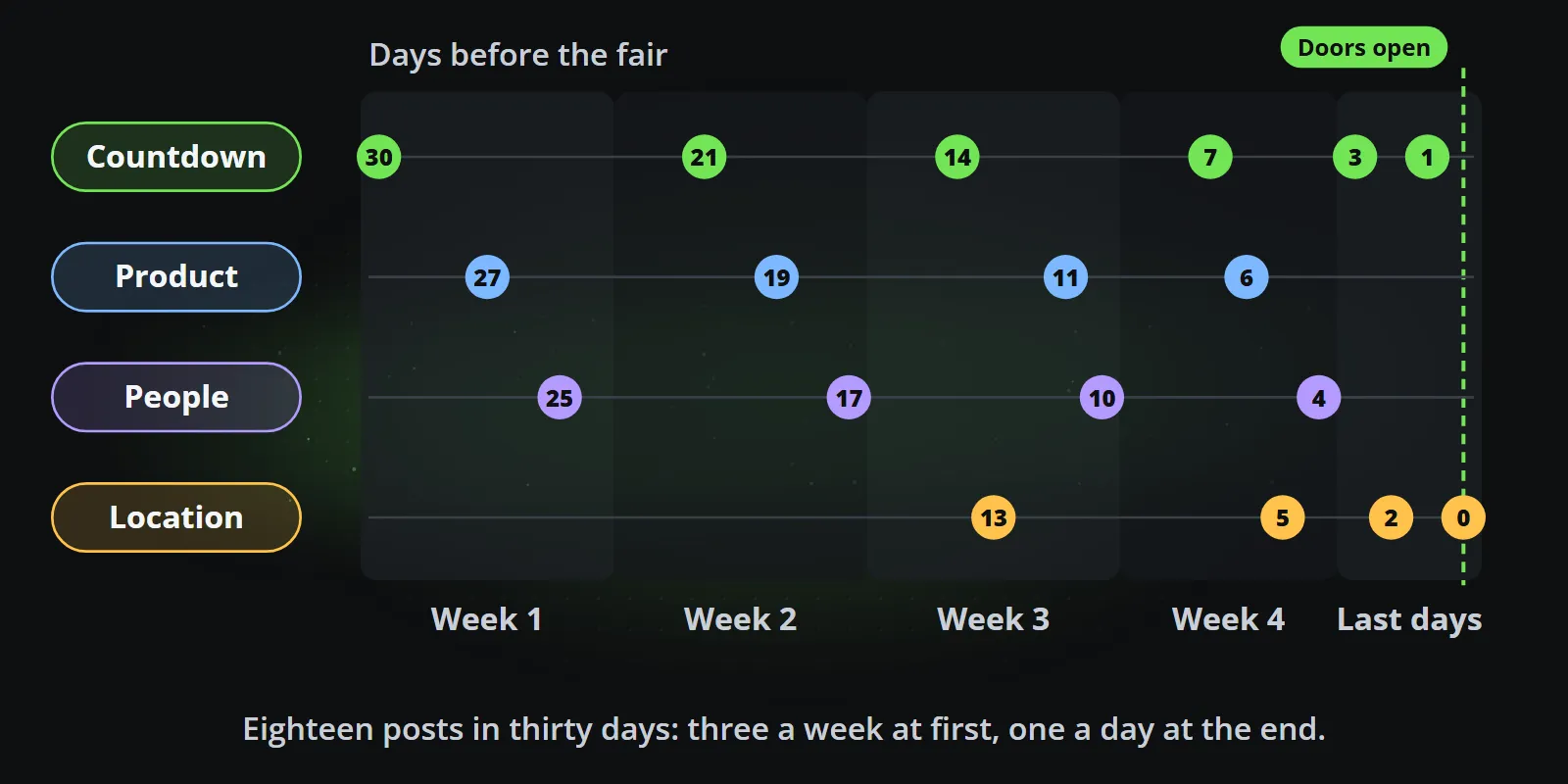
Week by week, that is eighteen posts:
| Days before | Countdown | Product | People | Location |
|---|---|---|---|---|
| 30 to 24 | Save the date (30) | First look at what you show (27) | Who will be on the stand (25) | |
| 23 to 17 | Three weeks (21) | One specification that matters (19) | An engineer answers a question (17) | |
| 16 to 10 | Two weeks (14) | One feature, explained (11) | The talk you give at the stand (10) | Hall and booth (13) |
| 9 to 4 | One week (7) | What is new this year (6) | Meet the team (4) | Book a meeting (5) |
| 3 to 0 | Three days (3), tomorrow (1) | How to find the stand (2), doors open (0) |
Countdown posts
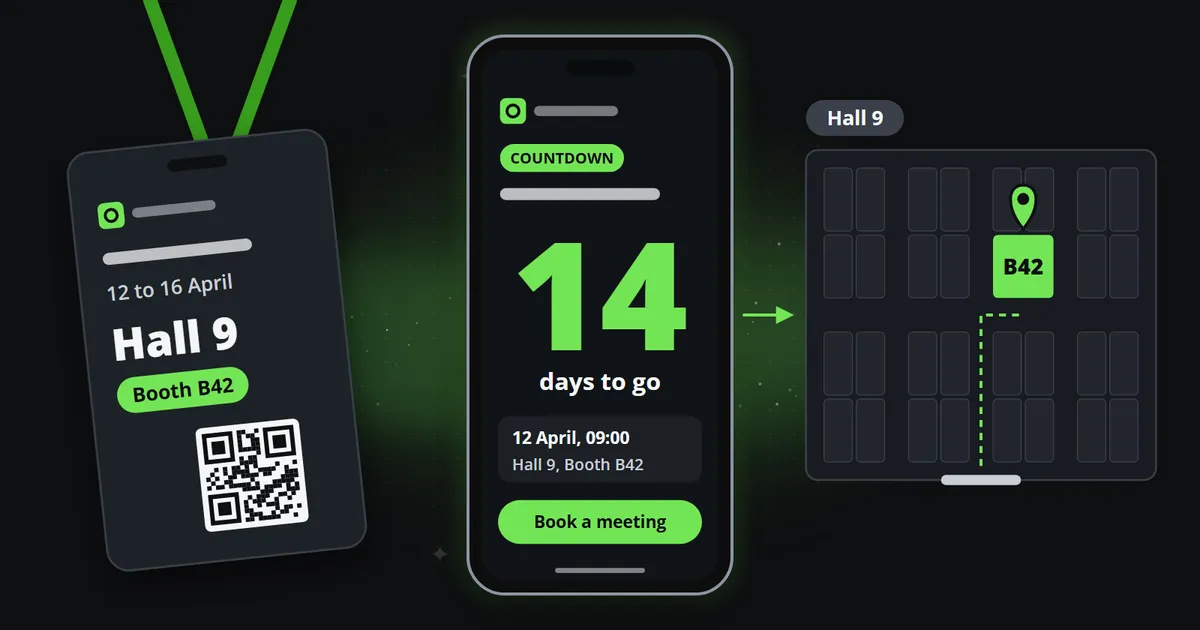
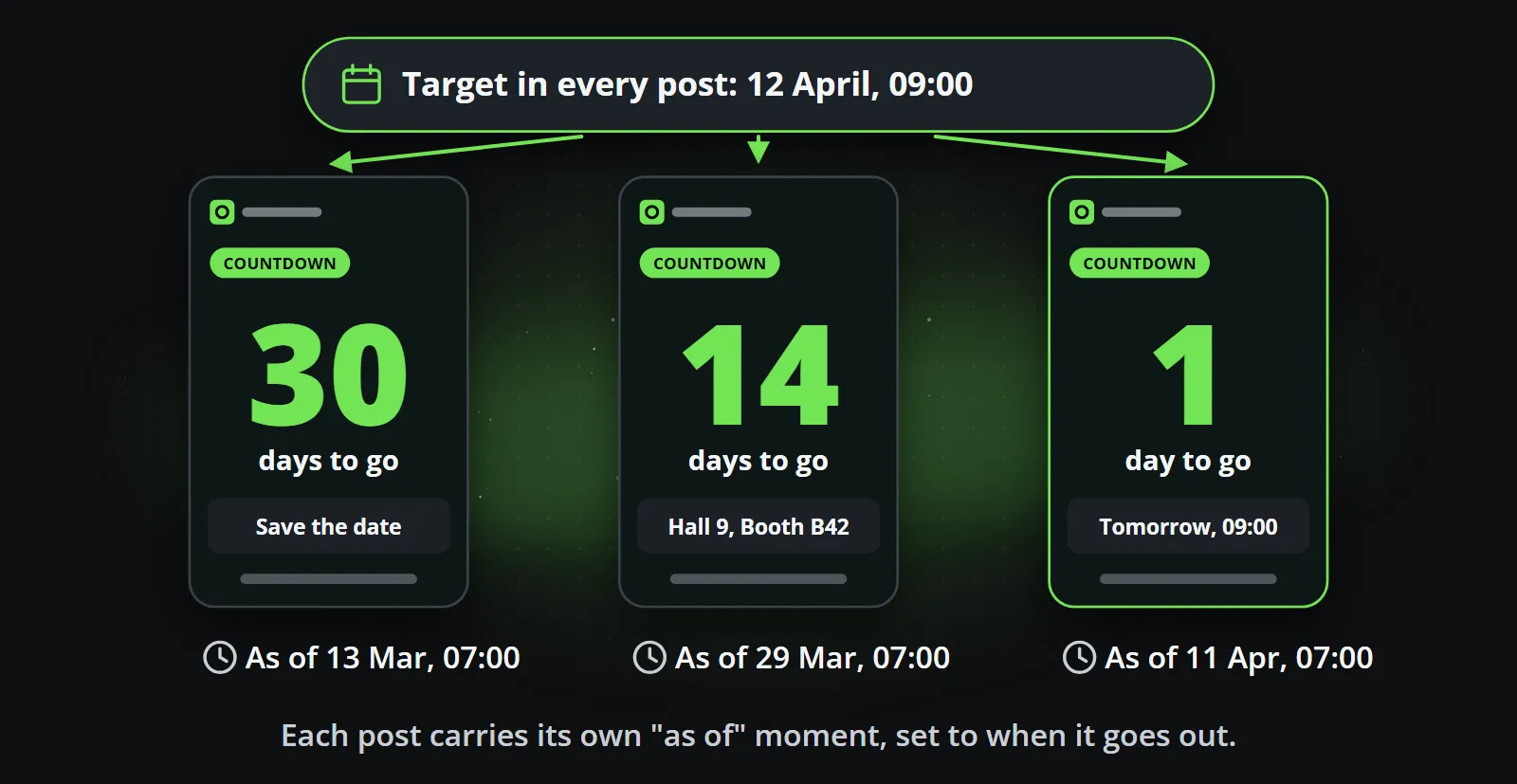
A countdown clip shows the days left, large, with the date written under it and a line of context. The detail that makes it work as a plan is where the number comes from. Reelwire’s countdown format takes two moments: the target, here the opening at 09:00 on the first day, and an “as of” moment the time is counted from. It never reads a clock, so a clip is the same whenever anybody watches it. Each countdown post in the plan therefore carries its own “as of”, set when it is written to the moment it goes out: the post for 13 March counts from 13 March, the post for 29 March from 29 March. As long as that field matches the post’s date, the number is exact.
It can also carry up to five more dates after the first, one at a time: the talks at the stand, a product demonstration, the evening reception. Each adds four seconds to the clip.
Product posts
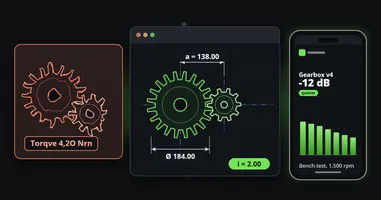
The product posts are where a technical audience looks hardest. A spec sheet with the real throughput, the real tolerance and the real weight, set in your typeface, says more to an engineer than a mood video. Reelwire’s Tech package has formats for exactly this: a spec sheet of one to nine specifications, a product launch with callouts pinned to the product’s picture, and a feature spotlight with one before and after figure. Every figure is drawn exactly as sent, which is the part generated video still gets wrong; what generative video cannot do explains why.
People posts
People buy from people, but nobody has to stand in front of a camera for it. A post with a name, a role, a picture the person chose and one line in their own words introduces the team just as well. A quote format draws the line word by word with who said it and the topic, which suits the question an engineer is asked most often. Faceless videos for business covers why formats like these hold attention without a presenter.
Location posts
The location posts carry the facts a visitor needs on the day. Reelwire’s trade fair template draws an event pass with the fair’s name, the dates, the venue, the hall and the booth, up to five things to see there, a floor plan finding the booth, and a call to book a meeting with your own contact person. With three highlights it runs about fourteen seconds.
Where does the content come from?
From four things that exist before anybody thinks about social media:
- The fair itself: name, dates, opening hours, hall, booth. One record, the same in every post.
- The product data: the data sheet or the product information system the specifications already live in.
- The people: who is on the stand on which days, and what each of them knows best.
- The programme: talks, demonstrations and meetings, with their times.
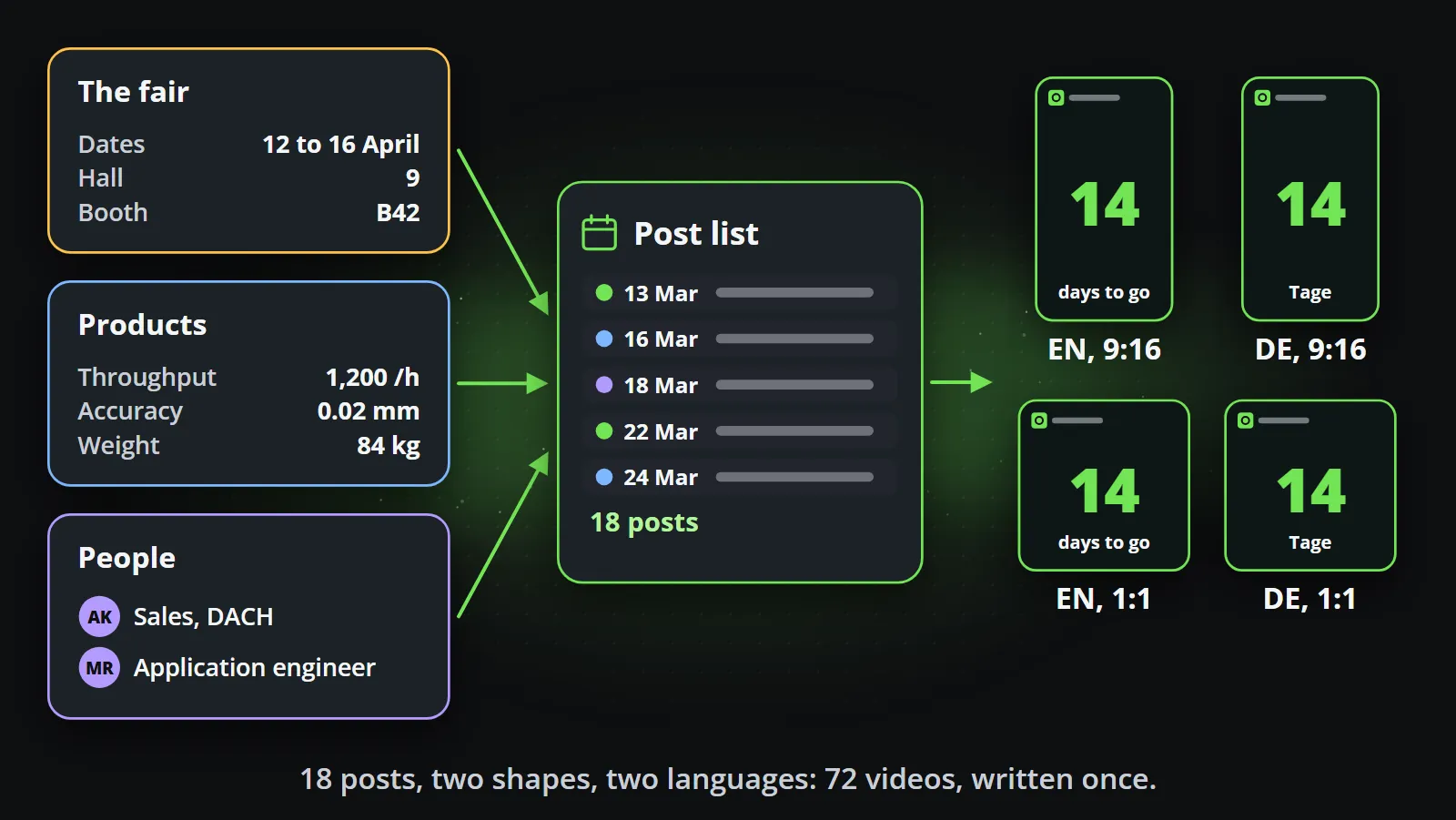
The simplest way is a post list in Reelwire’s Post composer: the eighteen posts written in an afternoon, each with its date and time, each publishing itself when its moment comes. If the fair’s dates and the programme already sit in your website’s event calendar, that calendar can send the posts over the API instead, made from the same record the website shows. Either way, the posts go through the same brand, templates and hand-over as everything else: by email with a page to post from a phone, by webhook to your own system or a posting service, or directly to LinkedIn (a personal profile), Slack, Discord or Telegram.
Plans change, and the posts have to follow. A talk that moves or a booth that changes is corrected in the post list before the post’s date. If a countdown post moves to another day, move its “as of” moment with it, or the clip still counts from the old one; if the fair itself moves, change the target in every countdown post still waiting. A post already handed over gets an update or a delete request, which goes the same ways the post went, so whoever posted it can change it or take it down.
If somebody has to see each post before it goes out, a channel can ask for approval per post, and the person who approves is told when one is waiting. Otherwise the templates are approved once and every post inherits that approval.
How do you reach an international audience?
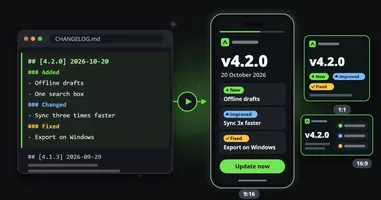
Trade fairs are international, and the plan should be too. A channel is one account in one language, so the same eighteen posts become a German channel, an English one and any other you need, each drawn in its own language and script; the words in the clip, from “days to go” to “Book a meeting”, are part of the content and are written per language. Each channel also has its own shape, 9:16 for Reels and Shorts, 1:1 or 4:5 for the feed, 16:9 for a screen on the stand, each laid out from the same template.
For the people going to the fair, a channel can post straight to a personal LinkedIn profile, so the sales engineer’s own followers see the countdown too, from that person’s own account.
The volume stays modest. Eighteen posts in two shapes and two languages is 72 videos, within the 75 a month of Reelwire’s Individual plan at €69; a larger set of channels fits the Small business plan’s 300.
What do you post during and after the fair?
The countdown ends when the doors open; the channel does not.
| When | Post | Format |
|---|---|---|
| Each morning of the fair | Today at the stand: talks and demonstrations with their times | Countdown with more dates |
| The day after it closes | Thank you, with figures you actually counted | Key figures that count up |
| The week after | The products people asked about most | Spec sheet or spotlight |
| A few weeks after | The date of next year’s fair | Countdown, a year long |
A thank you with figures is worth posting only with real figures: the template counts up to exactly the value sent, so it shows what you counted and nothing else. And the products shown at the fair keep appearing in the release notes afterwards, which release notes to video turns into a channel of its own.
Bottom line
A booked stand is a decision already made and paid for. The weeks before it ask for little that is not already written down somewhere: in the fair’s confirmation, the data sheet and the team’s calendar. Written once into a plan, with each countdown’s “as of” moment set to its own date, the posts make themselves, in every shape and language, on the right day, with the right number of days.
To see your own channel built from what you already publish, send the address of your news page, read more on Reelwire for tech and industry, or start on the free plan, 25 videos a month with no card.
Frequently asked questions
When should you start posting before a trade show?
Thirty days before is one workable span for a rhythm that does not wear people out: a save the date first, then three or four posts a week, and one a day in the last days before the doors open.
What should you post before a trade fair?
Four kinds of post: a countdown to the opening, the products you will show with their real figures, the people visitors will meet, and where to find the stand, with the hall, the booth and a way to book a meeting.
How do you make a trade show countdown video?
With a countdown template that takes two moments: the target, such as the opening, and the moment the time is counted from, which you set to when the post goes out. Each post in the plan carries its own, so the one published 30 days before says 30 days and the one published the day before says 1 day.
Can trade show posts be automated?
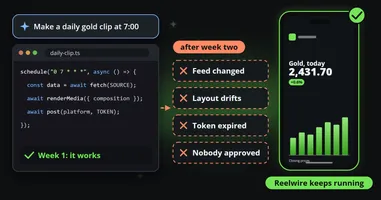
Yes. The posts are written once into a post list with their dates, or sent from the event calendar, and each one is rendered in every shape and language and handed over or posted on its day, without anybody opening an editor.
What should you post after a trade show?
A thank you with figures you actually counted, the products people asked about, and the date of the next fair. The countdown to next year can start the week after this one ends.

Co-founder of Reelwire. Every organisation has facts worth showing, its prices, results, releases and warnings, and the vision is that every one of them can show those facts every day, on brand, in every format and language, without a production team behind each post. Your data, in motion: correct, recognisable and consistent from the first clip to the thousandth.