Daily Market Update Videos: How Brokers Publish Every Day and Stay Compliant
A daily market update video keeps a broker visible, but every clip is a marketing communication. How to publish daily, approved once, for partners too.

Key takeaways
- Markets produce something worth posting every day, and short-form platforms reward exactly that. The bottleneck for a broker is producing compliant clips at that rhythm.
- Every market update is a marketing communication, so it has to be fair, clear and carry the right risk warning. Approving a template once, instead of each clip, makes daily volume safe.
- A generated chart is a claim nobody sourced. A template draws the price from your feed, so there is always an answer to "where did that number come from?"
- The same daily clips can reach your partner network ready to post, without anybody handing over a client list or account access.
Markets give a broker something new to say every single day. Prices move, the calendar brings CPI, payrolls and rate decisions, and every so often something breaks a record. A daily market update video is the natural format for that, and short-form platforms reward the brokers who show up with it every morning.
Almost none do, and the reason is not a lack of data. It is that every clip is a marketing communication, and producing compliant, on-brand video every day by hand is expensive, slow and risky. This article shows how brokers can publish the market every day, keep compliance in control, and extend the same content to their partners.
Why daily market videos work
Short-form video is shown to people who do not follow you yet, and every post starts from zero. That favours consistency over production value: a channel that posts a clean market update at the same time every morning tends to build a bigger audience than a monthly webinar.
Markets suit this better than almost any other subject:
- There is always news. Something moved overnight, something prints today.
- It is numeric. Levels, changes, rankings and percentages fit templates perfectly.
- It is time-bound. Being first with the number is most of its value.
- It is multi-market. The same update works in every language your clients speak.
What a good market update video contains
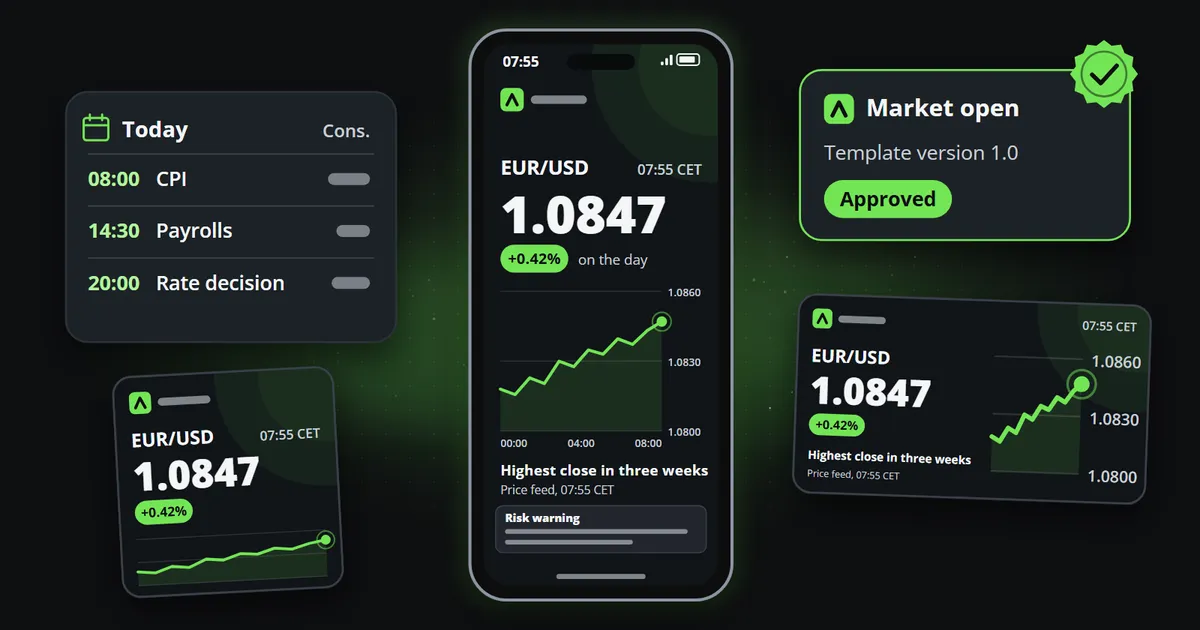
A ten to twenty second clip is plenty. It should be readable with the sound off and carry:
| Element | Example |
|---|---|
| The instrument and level | EUR/USD 1.0847 |
| The change and direction | +0.42% on the day, in your colour for up |
| The time and source | 07:55 CET, from your price feed |
| One factual line of context | Highest close in three weeks |
| Your brand | Logo, colours, typeface |
| The risk warning | The wording your regulator requires, in full and legible |
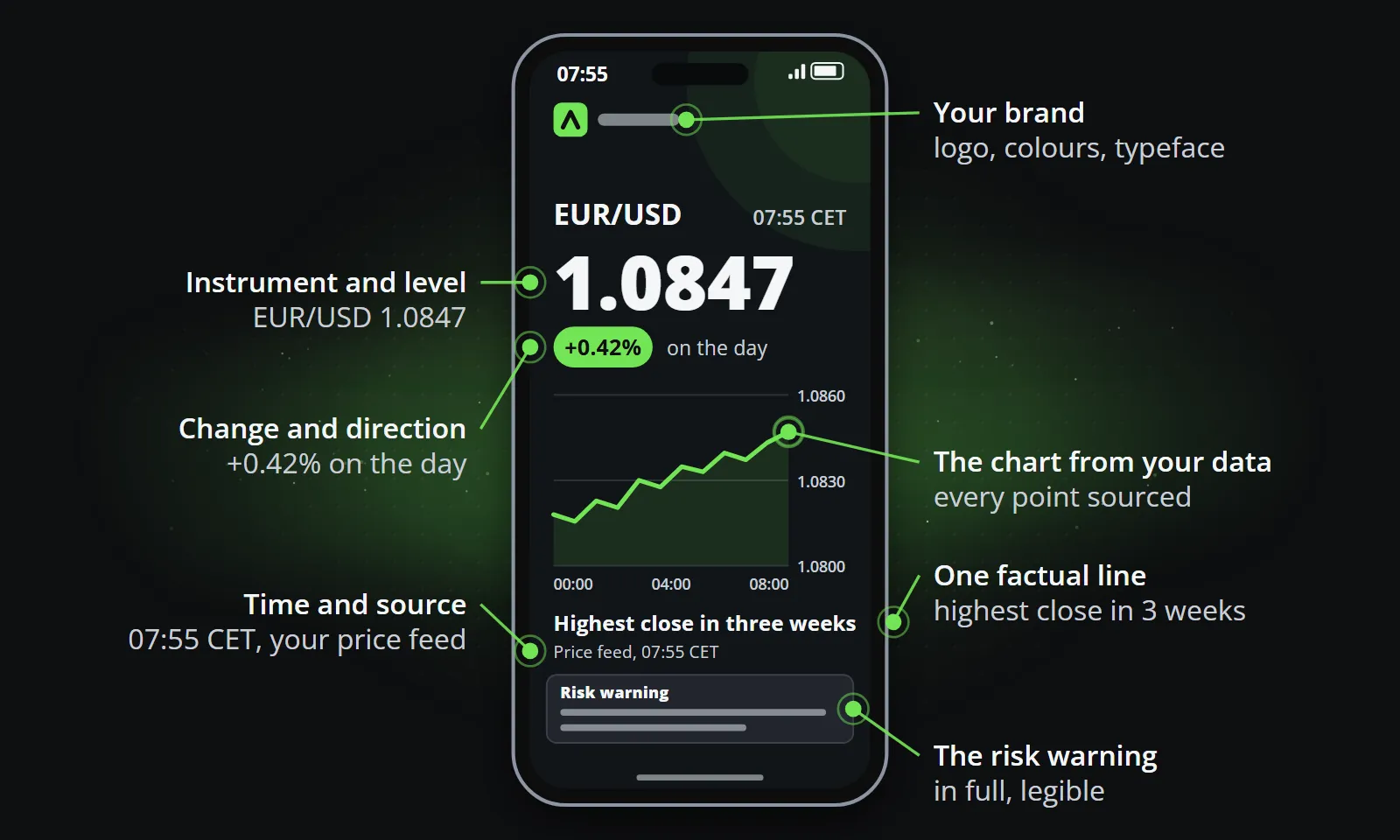
Useful recurring formats include the market-open snapshot, the closing recap, the top movers of the day, a currency strength ranking, the economic calendar for the day ahead, a commodity dashboard, and a milestone clip when something reaches a record.
The compliance problem, and how to make it a control
Every one of those clips is a marketing communication. Rules differ by jurisdiction and licence, but the common core is the same: communications must be fair, clear and not misleading, figures must be accurate and sourced, and required risk warnings must be shown properly. Regulators have also become more attentive to marketing on social media, including content that affiliates and finfluencers publish for a firm: the UK’s Financial Conduct Authority, for example, published finalised guidance on financial promotions on social media in March 2024 that also covers influencers and affiliate marketers (checked on 14 October 2026). This is not legal advice, and your compliance team will know your exact obligations.
Reviewing every clip by hand does not scale to daily. At two posts a day, in three aspect ratios and three languages, that is more than five hundred items a month for somebody to check.
The way out is to move the review from the clip to the template:
- The layout, the treatment and the disclaimer are fixed in a template. A designer builds it once; compliance reviews it once.
- The figures come from your feed, not from a person typing them and not from a model drawing them.
- The same data always makes the same clip. So the approved template version covers every clip made from it, and nothing in the clip can drift away from what was approved.
- Each clip is traceable: which template version, which brand version, which data, and when it was handed over.
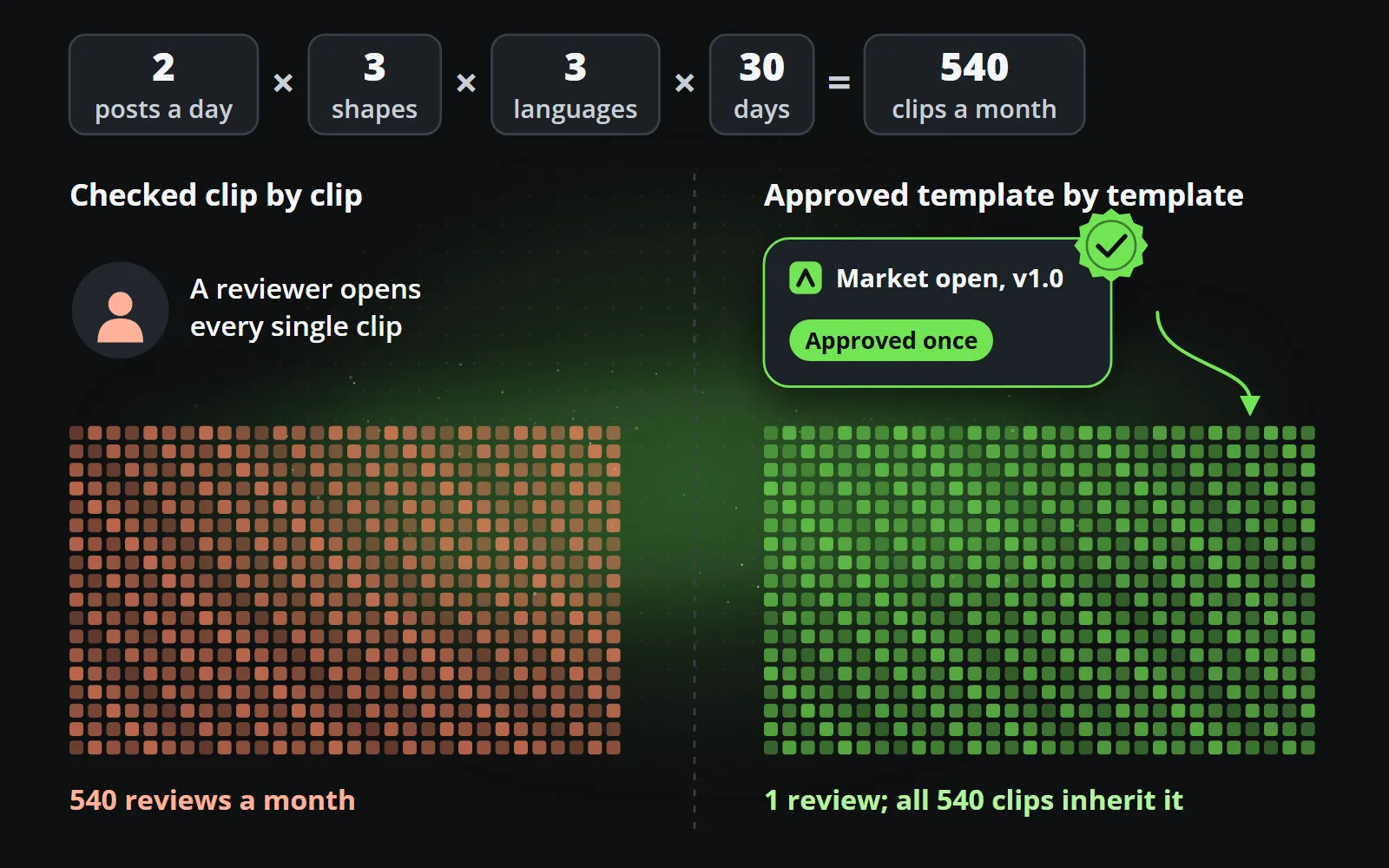
Reelwire works this way. A template version arrives pending and produces nothing until it is approved; once approved, every clip from it inherits that approval. For channels that need more, a person can also approve each post before it goes out. A handful of template reviews replace thousands of clip reviews, and compliance gets a control it can demonstrate instead of a backlog it cannot keep up with.
Why a generated chart is a compliance problem
AI video generators can make a convincing market clip from a prompt, and that is precisely the problem. If a generated video shows a price move, the move was drawn by a model. Nobody sourced it, nobody can reproduce it, and it went out under your licence with your logo on it. Digits can also change between frames, which no reviewer will catch at playback speed.
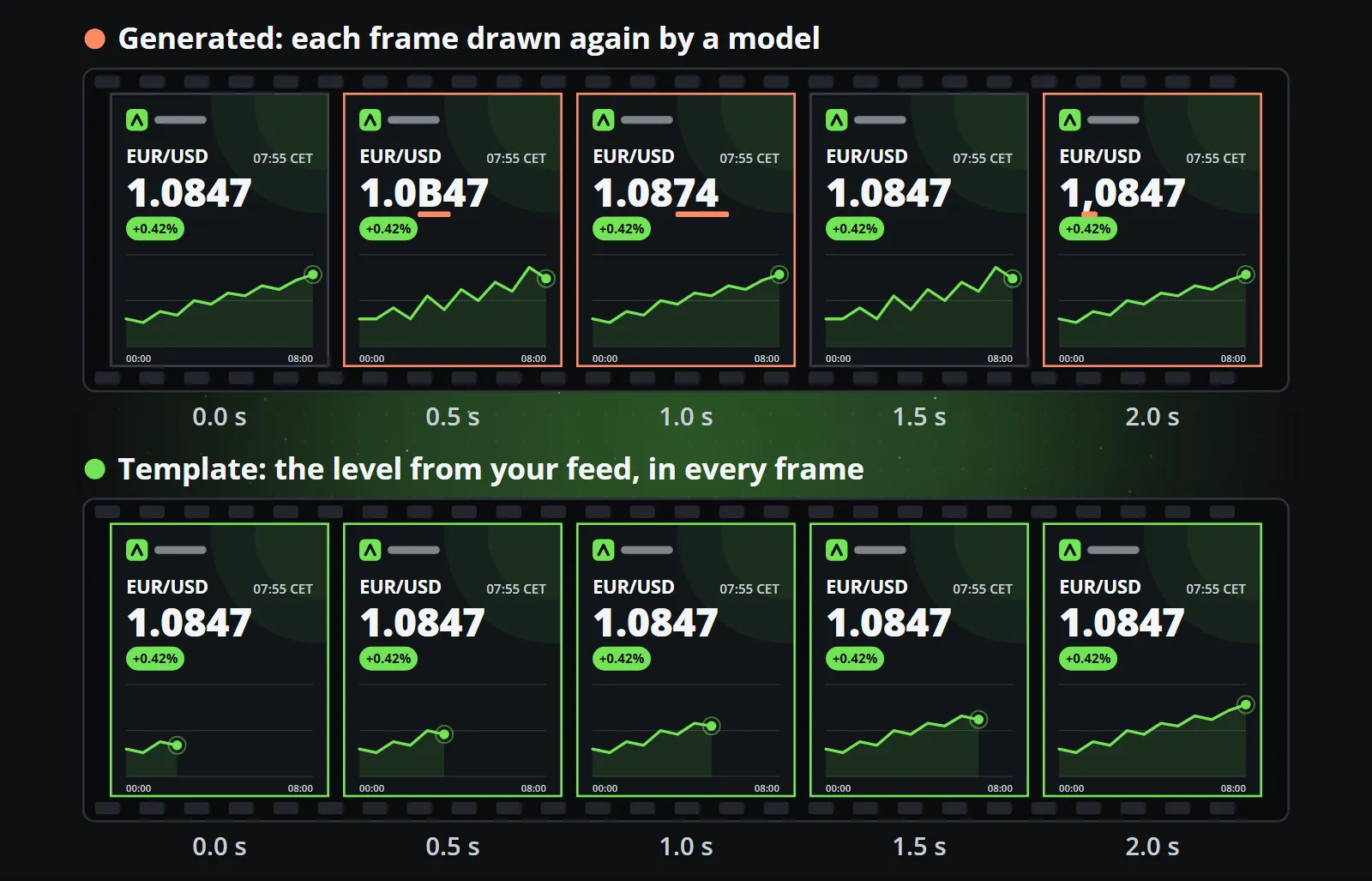
A template cannot do that. It draws the level and the change it was sent from your feed, in your typeface, and refuses anything that does not fit. When somebody asks where a number came from, there is an answer. AI video generator vs template video compares the two approaches in general.
Generated footage can still have a place, as a background picture or a short loop made once and reused. The price, the change and the warning should never be generated.
Feeding it: your data, your calendar, your research
A market channel needs three kinds of input, and most brokers already have all three:
- Prices and indicators from the trading platform or a market data source: levels, changes, highs and lows, rankings.
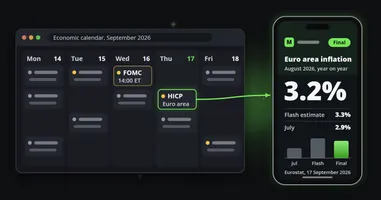
- The economic calendar: what prints today, the consensus, and the actual once it is out.
- Your own research: the analyst’s one-line view, a level to watch, a weekly outlook.
In Reelwire, each of these can arrive as data, from a ready-made feed, from your own system over the API, or from a post list your analysts fill in, and each new item becomes a post on every channel that listens to it. Data to video explains the three routes.
Every language, every shape, from one template
Most brokers serve several markets. A template lays out the same update in 9:16 for Reels, Shorts and TikTok, 4:5 and 1:1 for feeds, and 16:9 for YouTube and LinkedIn, and in every language your channels publish in. One approved design covers every ratio and language your channels need, and a correction to the template reaches every version at once.
Your partners can publish too
Many brokers have a network of introducing brokers, affiliates and finance creators. Most of them want to post daily and do not, because producing professional, compliant content is not what they are good at. Every partner who posts nothing is distribution the broker already paid to acquire.
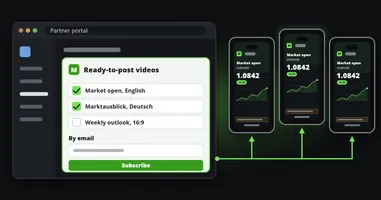
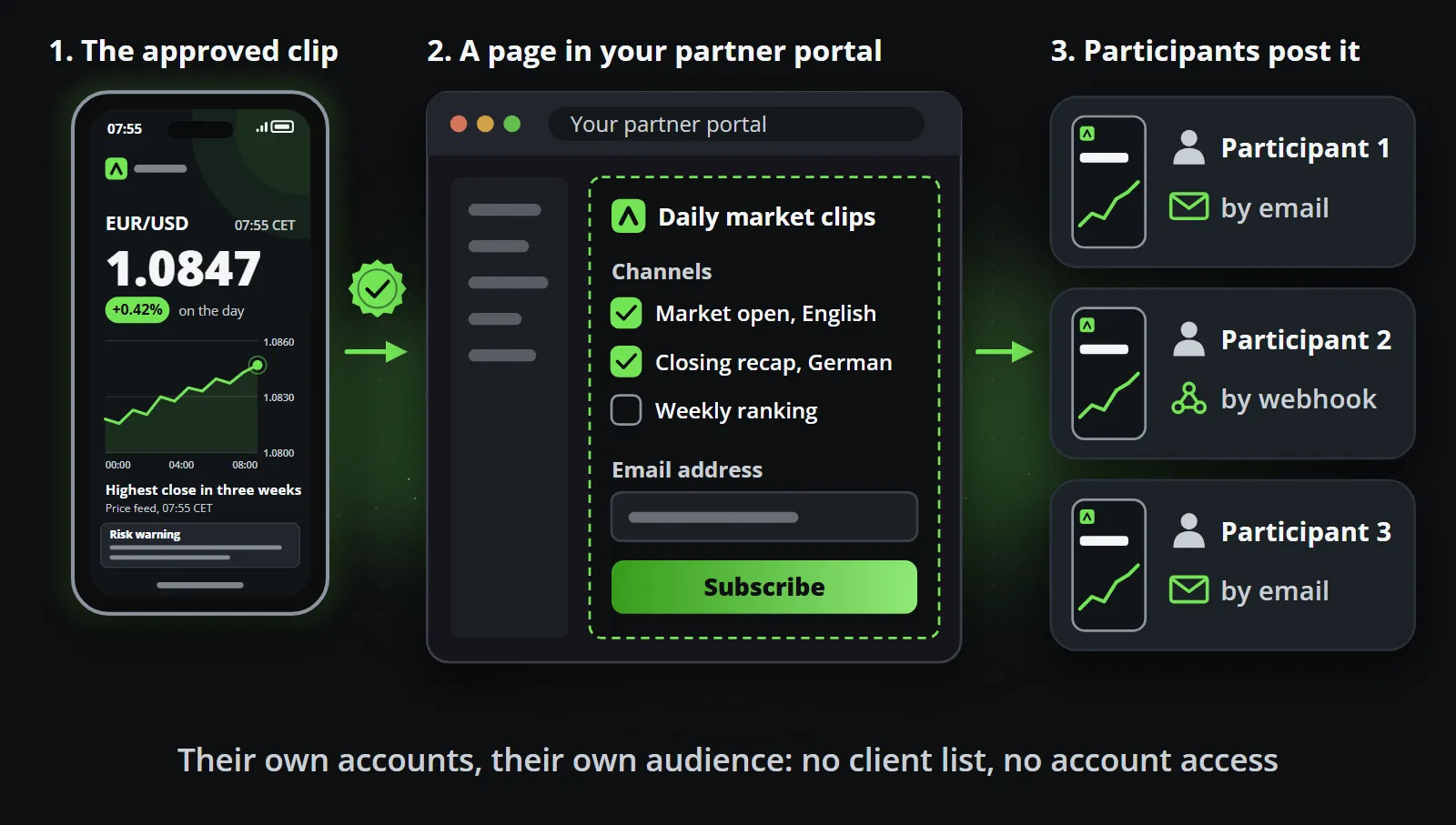
Reelwire’s syndication, on the Enterprise plan, hands the same daily clips to those partners:
- The broker puts a page for each group of channels inside its own partner portal.
- Partners, called participants, subscribe there, and receive each finished clip by email or webhook, ready to post.
- Every clip is the approved one, so what partners publish is what compliance signed off.
- Nobody hands over a client list, and nobody needs access to anybody’s social accounts.
The partner keeps their own audience and their own account; the broker gets consistent, approved content in front of that audience every day.
A simple daily schedule
| Time | Post |
|---|---|
| Before the open | The day ahead: calendar events and key levels |
| After a major release | The actual against the consensus, with the market’s first reaction |
| After the close | The day in one clip: top movers and closing levels |
| Weekly | The week’s ranking or a currency strength recap |
| When it happens | Milestones such as a record close |
Each line is one template, approved once, filled automatically.
Bottom line
A broker does not need more ideas for content; the market supplies a new one every day. What it needs is a way to publish that is fast, exact and approved before it exists. Templates filled from your own feed give compliance a single point of control and give your channels, and your partners’ channels, a daily presence that costs nobody their morning.
To see it on your own instruments, send three symbols and a day of your channel comes back on your brand, or read more on Reelwire for finance.
Frequently asked questions
What should a daily market update video include?
The instrument and the level, the change and its direction, the time and source of the data, one line of factual context, the brand, and the risk warning your regulator requires. Ten to twenty seconds is enough, built to be read with the sound off.
Are broker social media posts financial promotions?
In most jurisdictions, content a regulated firm publishes about its products or markets to win clients counts as marketing communication or a financial promotion, and must be fair, clear and not misleading, with the required warnings. This is not legal advice; check the rules that apply to your licence.
How can a broker approve hundreds of posts a month?
By approving the template rather than each post. When the layout, the disclaimer and the treatment are fixed in a template and the figures come from your feed, the same data always makes the same clip, so one review can cover every clip made from that template version, if your compliance team agrees that is enough.
Can introducing brokers and partners use the same videos?
Yes. With Reelwire's syndication, partners subscribe to the broker's channels on a page inside the broker's own partner portal and receive each finished clip by email or webhook, ready to post. Nobody shares a client list, and nobody needs access to anybody's accounts.
Should brokers use AI-generated market videos?
Not for the figures. A video model draws numbers as pixels and can change them between frames, which turns a chart into an unsourced claim. Generated footage can work as a background; the price, the change and the warning should come from data and a template.

Co-founder of Reelwire. Every organisation has facts worth showing, its prices, results, releases and warnings, and the vision is that every one of them can show those facts every day, on brand, in every format and language, without a production team behind each post. Your data, in motion: correct, recognisable and consistent from the first clip to the thousandth.