A Community Information Channel: The Local Paper's Service Page, Rebuilt for WhatsApp
Pharmacy on duty, bin days, water levels, market times: the local paper's service page is thinning out in places. How a city rebuilds it on WhatsApp.

Key takeaways
- The local paper's service page carried what residents needed every day: the pharmacy on duty, bin days, water levels, market times, opening hours and events. At least one official page still points people to the paper for the pharmacy on duty.
- Where printed papers shrink or stop being delivered, that page can go with them, although the information behind it is still kept by the same offices and services.
- A city can rebuild it as a community information channel: each section one template, filled from the data and posted at its own time.
- Telegram channels can be posted to by software. WhatsApp channels cannot, as far as Meta documents, so a city posts there from a phone with a finished clip.
For a long time, the local paper had a page many people turned to whatever else they read in it: the service page. The pharmacy on duty, which bins go out this week, the river level, the market times, the pool’s holiday hours. A community information channel is that page rebuilt for where residents are now, on a messenger or a social network, as short posts at fixed times, made from the same information the paper used to print.
This article looks at what the service page carried, why it is thinning out, how a city can rebuild it as a daily channel, and which messengers can carry it. For the wider case for municipal channels, see municipal social media; for ten formats in detail, see local government social media ideas.
What did the local paper’s service page carry?
Nothing glamorous, all of it useful, and the paper is still named as a place to find some of it. One official page, Baden-Württemberg’s service portal explaining how to find the pharmacy on duty, lists the chamber of pharmacists’ own search, a phone number and a text message service, and then adds: “Auch Tageszeitungen oder Amtsblätter enthalten meist Informationen zum Apothekennotdienst aus dem Einzugsbereich”, daily papers and official gazettes usually carry the pharmacies on duty nearby (the portal’s page on the pharmacy emergency service, checked on 14 October 2026).
| Section | Who keeps the information today | On a city channel? |
|---|---|---|
| Pharmacy on duty | The state chamber of pharmacists, which sets the rota (in Baden-Württemberg, the Landesapothekerkammer with its own search) | As a pointer to the chamber’s search, or by agreement with it |
| Doctors on call | The out-of-hours medical service, 116117 in Germany | A standing reminder of the number |
| Bin days | The waste service | Yes, the evening before |
| Water levels | Federal and state gauge services | Yes, every morning |
| Weather and warnings | The national weather service | Yes, and as warnings are issued |
| Market times | The markets office | Yes, weekly |
| Opening hours | The city’s offices, pools and libraries | Yes, before each change |
| Events | The city’s events calendar | Yes, for the week and the weekend |
| Official notices | The city | As a pointer to where they are officially published |
Every row still exists. Where the page that gathered them thins out, residents have to find each one on its own.
Why is the service page thinning out?
Printed local papers are under pressure from two sides that matter for a page like this: advertising and delivery. In the German newspaper publishers’ association’s report on 2023, regional subscription papers’ advertising revenue was almost 30 percent lower than five years earlier, and publishers named rising delivery costs as one of their biggest problems. The same report also shows the other side: their revenue from readers held at 4.21 billion euros, as price rises made up for falling circulation (BDZV, 2024, checked on 14 October 2026). Papers are not simply disappearing; they are changing what they print and where they deliver it.
In thinly populated areas, delivery itself can go. In 2023 a regional paper in Brandenburg ended delivery of its printed local edition in the district of Prignitz, about 2,800 subscribers, because delivery there was no longer economically viable, and moved it online (Horizont, 9 May 2023).
The service page is a small part of any of this, and it can thin out without anybody deciding that it should. Residents who relied on it notice anyway: the information did not stop mattering, it stopped arriving in one place.
What does a community information channel look like?
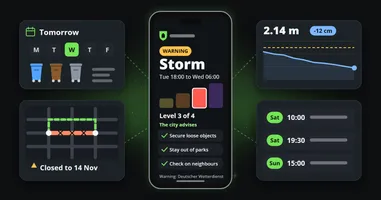
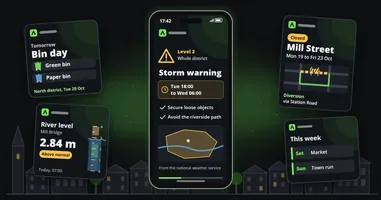
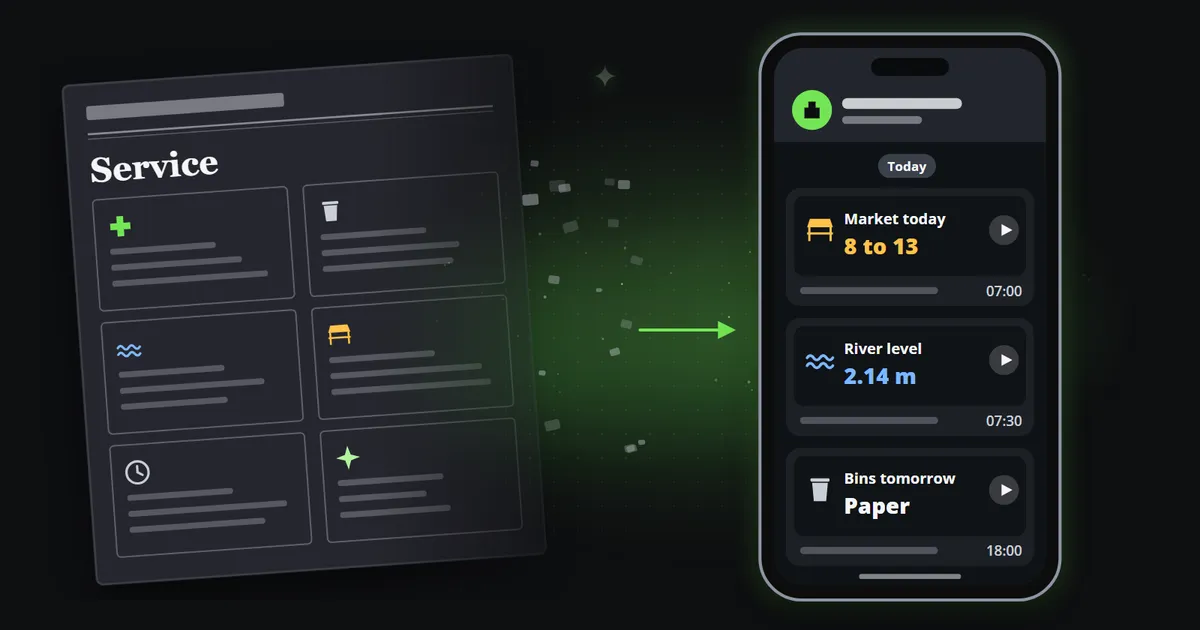
It looks like the service page, taken apart into its sections and put back together in time. Each section becomes one template in the city’s look, filled from the data every time it changes, and posted at the moment it is useful rather than all at once in the morning paper.
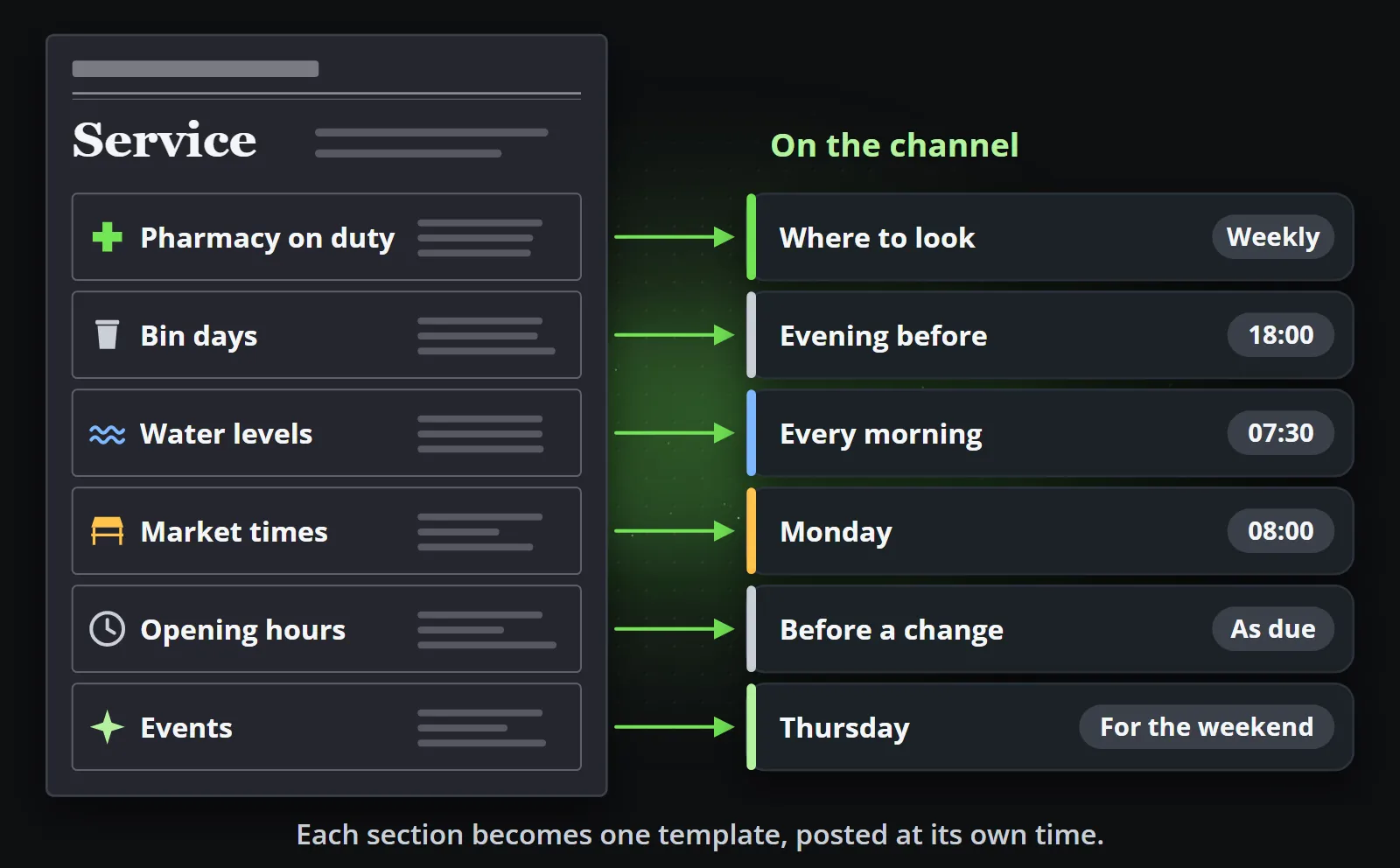
Three things make it work without an editor:
- The data comes from its keeper. The gauge reading is the gauge’s, the collection day is the waste service’s, the events are the events calendar’s. Some arrive without any work at all: Reelwire’s ready-made feeds already carry the Rhine gauges, the pollen forecast and the Deutscher Wetterdienst’s severe weather warnings for the whole country, by state. The city’s own data reaches its templates over an API, and what somebody writes by hand, such as a change of market day, goes into a post list for its date.
- The design is approved once. The press office signs off each template a single time, and every post made from it looks exactly like what was approved. A line that is too long is refused by name, not squeezed into the frame.
- The timing is the format. Residents learn that the river level comes at half past seven and the bins at six in the evening. A channel that keeps its times is easier to rely on, the way the same page was in the same place every day.
The full set is about two dozen posts a week, and far fewer to start with. Nearly none of them needs a person to make it.
Which messengers can carry a community information channel?
WhatsApp is usually the first messenger a city thinks of, because residents use it every day. Whether software can post there is a different question, and the answer differs by messenger.
| Messenger | What it offers | Can software post to it? | How a clip gets there |
|---|---|---|---|
| Channels: one-way, followers’ numbers not shown to the admin | Not as far as documented, checked on 14 October 2026 | Handed over by email, posted from a phone | |
| Telegram | Channels with any number of subscribers | Yes, through a bot that is an administrator | Posted directly by Reelwire’s Telegram connector |
| Threema | Threema Broadcast, part of Threema Work | Yes, its API can dispatch broadcast messages | Handed over by webhook to the city’s system |
WhatsApp channels are one-way broadcasts. WhatsApp’s privacy policy for channels says that following one does not reveal the follower’s phone number to the admin or to other followers, and that channel updates are kept on WhatsApp’s servers for up to 30 days (WhatsApp’s channels privacy policy, checked on 14 October 2026). Meta’s documentation describes no way for an app to post to a channel (the WhatsApp Business Platform documentation, checked on 14 October 2026), so an official account is best run the way Meta documents it: from the app.
Telegram channels are made for this: Telegram’s FAQ says a channel can have any number of subscribers. Its Bot API lets a bot post a video to a channel by the channel’s @name, files of up to 50 MB, once the bot is an administrator there (Telegram Bot API, checked on 14 October 2026). The city makes the bot itself in a minute and keeps it; Reelwire’s Telegram guide walks through it.
Threema Broadcast is the broadcast tool in Threema Work, Threema’s service for organisations (Threema Broadcast), and its API can dispatch broadcast messages and manage feeds, distribution lists and groups (Threema Broadcast API, both checked on 14 October 2026). A webhook from Reelwire hands each finished clip to the city’s own system, which sends it on.
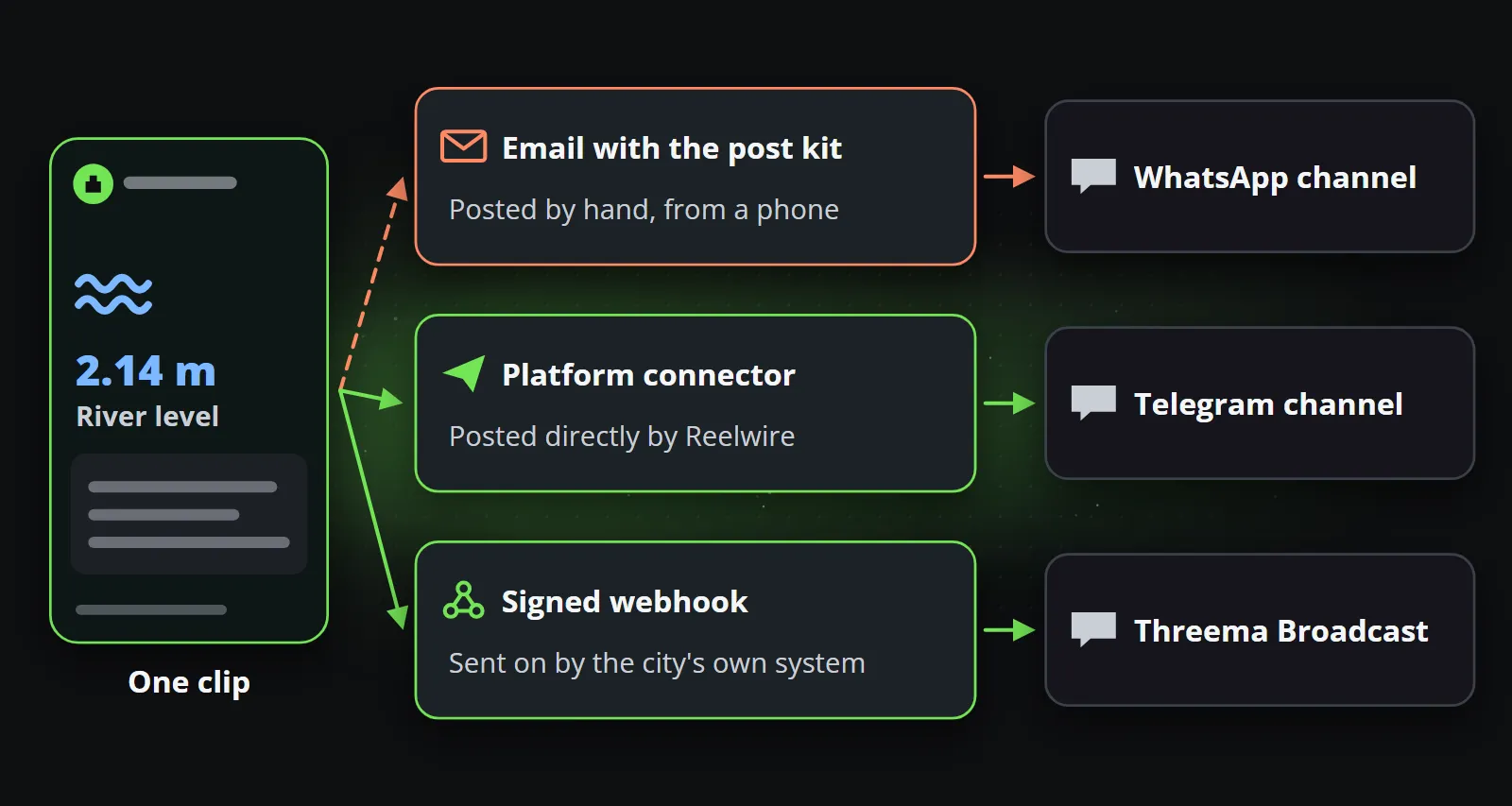
The WhatsApp route is less work than it sounds. The finished clip arrives by email with a link to a page holding the video, its text with a Copy button, and Mark as published. Posting it to the channel from a phone is a matter of a minute or two. The city keeps its own account, and nobody outside the office ever needs access to it.
Whether and how a public body may run a channel on a given messenger is a question for its data protection officer and its own rules. Nothing here is legal advice, and it reflects the platforms’ pages as checked on 14 October 2026.
How do you start?
The same way the paper’s page was filled: one section at a time.
- Pick the section residents ask about most. Often that is the bin calendar, or, in a town on a river, the river level, and both usually have their data ready.
- Pick one messenger. Telegram if you want it to run with nobody in between, WhatsApp if that is where residents are and somebody can post once or twice a day.
- Fix the time. Six in the evening for tomorrow’s bins, half past seven for the river. Keep it.
- Add the next section when the first one runs. Each is one template more, not one job more.
A community information channel of one section, posted daily in one shape, is about 30 videos a month: within Reelwire’s Individual plan of 75 videos for €69 a month, and a weekly section fits the free plan’s 25. From event to post shows the four steps every one of these posts goes through.
Bottom line
Where the service page is thinning out, it is not because residents stopped needing the bin calendar or the river level. It is because the paper around it is under pressure. The information is still there, kept by the same offices, and a city can put it back together where its residents read now, one section at a time, without anybody having to make each post by hand.
To rebuild one section with one department, ask about a pilot, see what Reelwire does for public bodies, or start on the free plan, 25 videos a month with no card.
Frequently asked questions
What is a community information channel?
A channel on a messenger or social network where a city or a district publishes the practical information residents use every day, such as bin days, water levels, opening hours and events, as short posts at fixed times. It does the job the local paper's service page used to do.
Can a city post automatically to a WhatsApp channel?
Not as far as Meta documents it. WhatsApp channels are run from the WhatsApp app, and Meta's documentation describes no way for an app to post to a channel (checked on 14 October 2026). A finished clip can be handed over by email and posted from a phone.
Which messenger can a city post to automatically?
Telegram: its Bot API lets a bot that is an administrator of a channel post videos there, and Reelwire's Telegram connector does exactly that. Threema Broadcast, part of Threema Work, has an API that can dispatch broadcast messages from the city's own systems.
Do residents' phone numbers become visible to a city running a WhatsApp channel?
According to WhatsApp's channels privacy policy, following a channel does not reveal a follower's phone number to the admin or to other followers, and channel updates are kept on WhatsApp's servers for up to 30 days. Check the current policy and ask your data protection officer before you start.
Can a city publish the pharmacy on duty?
The rota is set by the state chamber of pharmacists, which publishes it itself. A city can point residents to the chamber's own search, or agree with the chamber how its rota may be shown on the city's channel.

Co-founder of Reelwire. Every organisation has facts worth showing, its prices, results, releases and warnings, and the vision is that every one of them can show those facts every day, on brand, in every format and language, without a production team behind each post. Your data, in motion: correct, recognisable and consistent from the first clip to the thousandth.